
What Kind vs What Kinds in English Grammar (30+ Alternatives)
“What kind of books do you like?” — correct or incorrect? If you hesitated, you’re not alone. The difference between what kind and what kinds trips up ESL learners, native speakers, and professional writers alike. And once you nail that rule, you’ll unlock 30+ powerful alternative phrases that make your English sound sharper, more natural, and far more expressive.
This guide breaks down the what kind vs what kinds rule in the clearest possible way, then gives you over 30 correct alternatives — from what type of and what sort of to more formal phrases used in academic writing, business communication, and everyday speech. Whether you’re an ESL learner, a student, or a professional writer, by the end of this article, you’ll never second-guess this grammar point again.
Quick Answer — The Core Rule
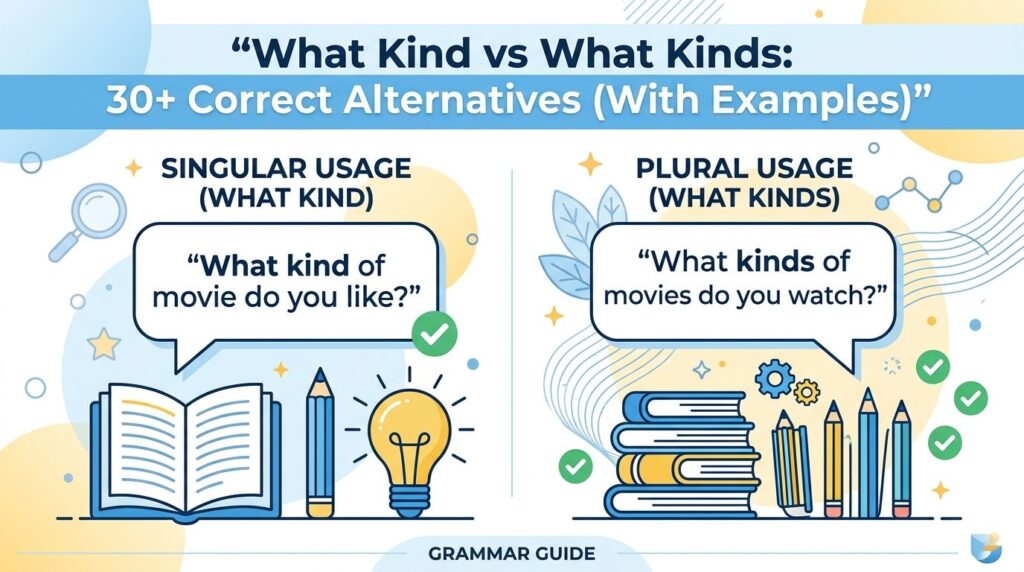
- What kind of → used with singular nouns or uncountable nouns (one type expected)
- What kinds of → used with plural countable nouns (multiple types expected)
- Key test: Is the noun after it singular or plural?
- “What kind of music do you like?” (uncountable — correct)
- “What kinds of books do you enjoy?” (plural — correct)
- “What kind of books do you enjoy?” (plural noun — incorrect in formal writing)
What Kind of vs What Kinds of: The Simple Grammar Rule
The difference between kind and kinds comes down to one thing: grammatical number. English grammar requires that the form of your question phrase match the noun that follows it. This is called noun agreement, and it’s at the heart of singular vs plural usage.
- Kind = singular → refers to one category, one type, one class of thing
- Kinds = plural → refers to multiple categories, several types, a range of things
The word “of” always follows both forms. You never say “what kind of music” — it’s always “what kind of music.” That “of” links the question phrase to whatever noun you’re asking about.
Understanding Singular vs Plural Nouns in This Context
The noun that comes directly after “what kind of” or “what kinds of” determines which form you need. Here’s a straightforward way to think about it:
What kind of car do you drive? (singular countable noun)
What kind of advice are you looking for? (uncountable noun)
What kinds of books do you recommend? (plural countable noun)
What kind of books do you recommend? (plural noun — use “kinds” here)
What kinds of information do you need? (uncountable noun — use “kind” here)
⚠️ Informal vs Formal: Native speakers frequently say “what kind of movies” in casual speech, even though movies is plural. This is acceptable conversationally, but in academic writing, formal emails, and grammar exams, always use the correct form of movies when the noun.
What Kind of vs What Kinds of: Side-by-Side Comparison
| Feature | What Kind of | What Kinds of |
|---|---|---|
| Noun type that follows | Singular or uncountable | Plural countable |
| Number of answers expected | One (a specific type) | Multiple (a range of types) |
| Question focus | Specific, narrow | Open-ended, broad |
| Formality level | Formal and informal | Formal and informal |
| Example (correct) | What kind of music do you play? | What kinds of songs do you play? |
| Common mistake | Using with uncountable: “what kinds of advice?“ | Use “kind of” (treated as a singular unit) |
| Collective nouns (team, family) | Use “kind of” (treated as singular unit) | Generally avoided |
30+ Correct Alternatives to “What Kind” and “What Kinds.”
English is rich with phrases that ask about type, category, and variety. The alternatives below follow the same singular/plural logic as what kind / what kinds. Each one has a singular form (for one type) and a plural form (for multiple types). Knowing these gives you flexibility across formal, casual, British, American, academic, and technical contexts.
1. What Type of / What Types of
What type of
Formal / Technical
Slightly more formal than “what kind of.” Common in professional, scientific, and academic settings. Use with singular or uncountable nouns.
Example: “What type of contract are we signing?” / “What type of fuel does this engine use?”
What types of
Formal / Technical
The plural form — use when asking about multiple categories or varieties. Follow with a plural countable noun.
Example: “What types of jobs are available in this field?” / “What types of materials were used?”
2. What Sort of / What Sorts of
What sort of
British English
Very common in British and Australian English. Equivalent to “what kind of” — warm, conversational, and slightly informal.
Example: “What sort of person are you looking for?” / “What sort of weather do you prefer?”
What sorts of
British English
Plural form used in British English for multiple types. Natural and commonly heard in everyday UK conversation.
Example: “What sorts of books does she enjoy reading?” / “What sorts of activities are planned?”
3. What Form of / What Forms of
What form of
Academic
Used when asking about format, structure, or method. Works well in academic, administrative, or scientific contexts.
Example: “What form of payment do you accept?” / “What form of government does this country have?”
What forms of
Academic
Plural version — ask about multiple formats or structures simultaneously. Useful in research and formal writing.
Example: “What forms of identification are required?” / “What forms of transport are available?”
4. What Category of / What Categories of
What category of
Academic / Analytical
Asks about classification or grouping. Strong choice in data analysis, research, product classification, or academic discussions.
Example: “What category of software does this fall under?”
What categories of
Academic / Analytical
Used to ask about multiple classifications at once. Excellent for formal reports, surveys, or research methodology sections.
Example: “What categories of products does your store carry?”
5. What Variety of / What Varieties of
What variety of
Descriptive
Focuses on diversity and range. Natural in food, agriculture, biology, and everyday descriptive speech.
Example: “What variety of apple is used in this pie?” / “What variety of English do you teach?”
What varieties of
Descriptive
Plural form emphasizing a diverse range of options. Ideal for detailed comparisons or descriptive academic writing.
Example: “What varieties of roses grow in this climate?”
6. What Style of / What Styles of
What style of
Creative / Casual
Focuses on design, manner, or approach. Common in discussions about art, fashion, writing, architecture, and behavior.
Example: “What style of management works best for remote teams?”
What styles of
Creative / Casual
Asks about multiple approaches or designs. Great for comparisons in creative or professional contexts.
Example: “What styles of architecture are found in this city?”
7. What Model of / What Models of
What model of
Technical
Specific to products, machines, systems, or versions. Use when differences between editions or designs matter.
Example: “What model of laptop are you using?” / “What model of phone should I buy?”
What models of
Technical
Plural — useful in sales, reviews, or comparisons. Asks about a range of product versions or designs.
Example: “What models of electric cars are most reliable?”
8. What Category of
- Meaning: Asks about classification within a system
- Usage: Academic, analytical, or technical writing
- Tip: Ideal when working with organized systems or databases
- Example: What category of expense does this fall under?
9. What Class of
- Meaning: Asks about a grouping or division
- Usage: Science, education, formal writing
- Tip: Common in scientific and taxonomic discussions
- Example: What class of medication is this?
10. What Brand of
- Meaning: Asks about a specific manufacturer or label
- Usage: Shopping, product comparisons, consumer topics
- Tip: Use when asking specifically about commercial products
- Example: What brand of laptop do you recommend?
11. What Model of
- Meaning: Asks about a specific design or version
- Usage: Technology, cars, electronics, machinery
- Tip: Sounds very professional and specific
- Example: What model of camera did you use for this shot?
12. What Version of
- Meaning: Asks about a specific edition or release
- Usage: Software, apps, documents, publications
- Tip: Very precise; use in technical contexts
- Example: What version of the software are you running?
13. What Genre of
- Meaning: Asks about a category within creative works
- Usage: Books, movies, music, games
- Tip: Specific to creative categories — avoid in non-creative contexts
- Example: What genre of novel do you enjoy most?
14. Which Type of
- Meaning: A selective version of “what type of.”
- Usage: When choosing from defined options
- Tip: Use when there’s an implied list of possibilities
- Example: Which type of contract is more suitable?
15. What Variety of
- Meaning: Asks about a subtype within a broader group
- Usage: Biology, food, agriculture, consumer goods
- Tip: Natural in casual and semi-formal conversations
- Example: What variety of apple grows best in this climate?
16. What Design of
- Meaning: Focuses on visual or structural characteristics
- Usage: Architecture, product development, fashion
- Tip: Ideal for anything that has a physical or visual form
- Example: What design of bridge is the most durable?
17. What Format of
- Meaning: Asks about the layout, structure, or presentation
- Usage: Documents, files, presentations, media
- Tip: Perfect for digital or media-related contexts
- Example: What format of file should I submit?
18. What Flavor of
- Meaning: Asks about a specific taste or subtle variation
- Usage: Food, but also used metaphorically in tech and writing
- Tip: Great for casual, creative, or tech discussions
- Example: What flavor of programming language do you enjoy?
Plural Alternatives to “What Kinds of”
These phrases function like “what kinds of” — asking about multiple types or categories.
19. What Types of
- Meaning: Asks about multiple categories
- Usage: Formal and informal; very common
- Tip: The most direct alternative to “what kinds of.”
- Example: What types of books do you usually read?
20. What Sorts of
- Meaning: Asks about multiple natures or varieties
- Usage: British English; both formal and casual
- Tip: Perfectly natural alternative for “what kinds of.”
- Example: What sorts of activities do you enjoy on weekends?
21. Which Kinds of
- Meaning: Asks about specific multiple categories from a known group
- Usage: When comparing defined options
- Tip: More selective than “what kinds of.”
- Example: Which kinds of exercises are best for lower back pain?
22. What Forms of
- Meaning: Asks about multiple structures or formats
- Usage: Academic or professional writing
- Tip: Abstract and formal — use in analytical writing
- Example: What forms of communication are most effective in remote teams?
23. What Categories of
- Meaning: Multiple classification groups
- Usage: Systematic or database contexts
- Tip: Very organized-sounding; great for formal presentations
- Example: What categories of expenses are tax-deductible?
24. What Varieties of
- Meaning: Multiple subtypes within a broader group
- Usage: Biology, food, products, nature
- Tip: Sounds natural and precise in both casual and formal settings
- Example: What varieties of grapes are grown in this region?
25. What Styles of
- Meaning: Multiple aesthetic or design approaches
- Usage: Art, writing, fashion, architecture
- Tip: Use when discussing creative or visual choices
- Example: What styles of architecture are found in this city?
26. What Classes of
- Meaning: Multiple groupings or divisions
- Usage: Science, biology, academic writing
- Tip: Sounds academic and structured
- Example: What classes of antibiotics are commonly prescribed?
27. What Models of
- Meaning: Multiple designs or product versions
- Usage: Business, technology, product sales
- Tip: Common in sales and technical contexts
- Example: What models of electric vehicles are available this year?
28. What Versions of
- Meaning: Multiple editions or releases
- Usage: Software, publications, digital tools
- Tip: Very common in tech discussions
- Example: What versions of this software are still supported?
29. What Genres of
- Meaning: Multiple creative categories
- Usage: Books, films, music, gaming
- Tip: Natural for entertainment and creative industries
- Example: What genres of music do you listen to while working?
30. What Formats of
- Meaning: Multiple layout or presentation options
- Usage: Media, documents, digital files
- Tip: Use in digital or content-related conversations
- Example: What formats of video does this platform support?
Context-Specific & Formal Alternatives
31. Which Category Fits Best
- Meaning: Asks for a judgment-based categorization
- Usage: Decision-making and analytical discussions
- Example: Which category fits best — fixed or variable costs?
32. What Specific Type of
- Meaning: Emphasizes precision and detail
- Usage: Formal, technical, or academic
- Example: What specific type of material is required for this project?
33. Could You Specify the Type of
- Meaning: Politely requests clarification on the category
- Usage: Professional emails and meetings
- Example: Could you specify the type of report you need?
34. What Exactly Are You Referring To
- Meaning: Requests precise clarification
- Usage: Formal and professional conversations
- Example: What exactly are you referring to by “support”?
35. Please Specify the Relevant Category
- Meaning: A directive version; asks someone to define the group
- Usage: Business communication, formal requests
- Example: Please specify the relevant category before we proceed.
36. In What Way Would You Classify
- Meaning: Asks how something should be organized or labeled
- Usage: Academic writing, analytical discussions
- Example: How would you classify this type of energy?
Additional Alternatives at a Glance
| Singular Alternative | Plural Alternative | Best Context | Tone |
|---|---|---|---|
| What class of | What classes of | Biology, taxonomy, education | Academic |
| What nature of | What natures of | Professional/academic | Serious, analytical |
| Which kind of | Which kinds of | When choosing from known options | Semi-formal |
| Which type of | Which types of | Literary/old-fashioned | Formal |
| What manner of | What manners of | Literary / old-fashioned | Formal, poetic |
| What genre of | What genres of | Books, film, music | Creative |
| What version of | What versions of | Technology, publishing | Technical |
| What brand of | What brands of | Shopping, consumer goods | Casual |
| What format of | What formats of | Media, documents, data | Technical |
| What species of | What species of | Biology, nature (same form) | Scientific |
| What flavor of | What flavors of | Food, informal preferences | Casual |
| What grade of | What grades of | Quality, education | Neutral |
| What level of | What levels of | Skill, difficulty, hierarchy | Neutral |
| What branch of | What branches of | Knowledge, organization | Formal |
| What field of | What fields of | Academic, career, science | Academic |
| What range of | What ranges of | Products, data, options | Business |
How to Choose the Right Alternative: 4 Quick Rules
- Check the noun. Is it singular, uncountable, or plural? That single check resolves 90% of cases. Singular/uncountable → use the “of” form. Plural → use the “s” form.
- Match your register. “What sort of” works in British casual speech. “What type of” fits a business email. “What category of’ belongs in a research paper. Pick the phrase that matches your audience and setting.
- Say it aloud. Incorrect combinations usually sound wrong to the ear. If “what kinds of advice” sounds strange, that instinct is right — it is. Trust the sound test.
- Think about how many answers you expect. One specific answer → singular form. A list of answers → plural form. When in doubt, ask yourself: Am I looking for one thing or several?
Pro Tip for ESL Learners: The same singular/plural rule applies across all alternatives. Master it once with “what kind / what kinds,” and you automatically apply it correctly to “what type / what types,” “what sort / what sorts,” and every other phrase on this list.
Common Mistakes and How to Fix Them
What kinds of issues are we facing? (plural noun — correct)
What kind of issues are we facing? (plural noun — use “kinds”)
What kind of information do you need? (uncountable — correct)
What kinds of information do you need? (uncountable — use “kind”)
What kind of team do you manage? (collective noun — treated as singular)
What kinds of teams do you manage? (collective noun — use “kind”)
The most common mistake is pairing the singular form with a plural noun — for example, “what kind of books?” It happens because native speakers do it in casual speech, which creates a false impression that it’s always fine. For formal writing, always match the form to the noun.
Frequently Asked Questions
What is the difference between “what kind vs what kinds”?
“What kind” is used for a single category, while “what kinds” is used for multiple categories or types.
Can I use “what kind of” with uncountable nouns?
Yes — always. Uncountable nouns like music, advice, information, and furniture never take a plural form, so “what kind of” is always correct with them.
What is the difference between “what kind of” and “what type of”?
“What type of” is slightly more formal and technical; “what kind of” is neutral and works everywhere. Both follow the same singular/plural grammar rule.
Is “what sort of” the same as “what kind of”?
Yes, functionally. “What sort of” is more common in British English; “what kind of” is preferred in American English. Both follow identical grammar rules.
What should I use with collective nouns like “team” or “family”?
Use the singular form — “what kind of team” — because collective nouns are treated as a single unit in most American and British English contexts.
Does the same rule apply to “which kind” vs “which kinds”?
Yes, exactly. “Which kind of” is used when selecting from known options (more specific than “what”), and the singular/plural rule still applies based on the noun that follows.
Final Thoughts
The what kind vs what kinds distinction is one of those grammar rules that feels complicated until the moment it clicks — and then it feels obvious. One noun, one check: singular or plural? That’s it. Everything else follows.
More than that, mastering this rule hands you a whole toolkit of alternatives — “what type of,” “what sort of,” “what category of,” “what variety of,” and dozens more — each with its own nuance, tone, and ideal context. Use them deliberately, and your writing and speaking will sound noticeably more precise, fluent, and confident.
The next time you’re about to write “what kind of problems,” pause, notice the plural, and write “what kinds of problems” instead. That tiny correction is the mark of a careful, skilled communicator.
In the same way, learning other ways to say have a safe trip can help you sound more natural, fluent, and confident in everyday English conversations and writing.

Shoaib Ahmed is a passionate content writer and language enthusiast who specializes in simplifying complex words, slang, and abbreviations into easy-to-understand meanings. As the creator of MeanFind.com, he is dedicated to helping readers quickly find clear and accurate definitions without confusion.