
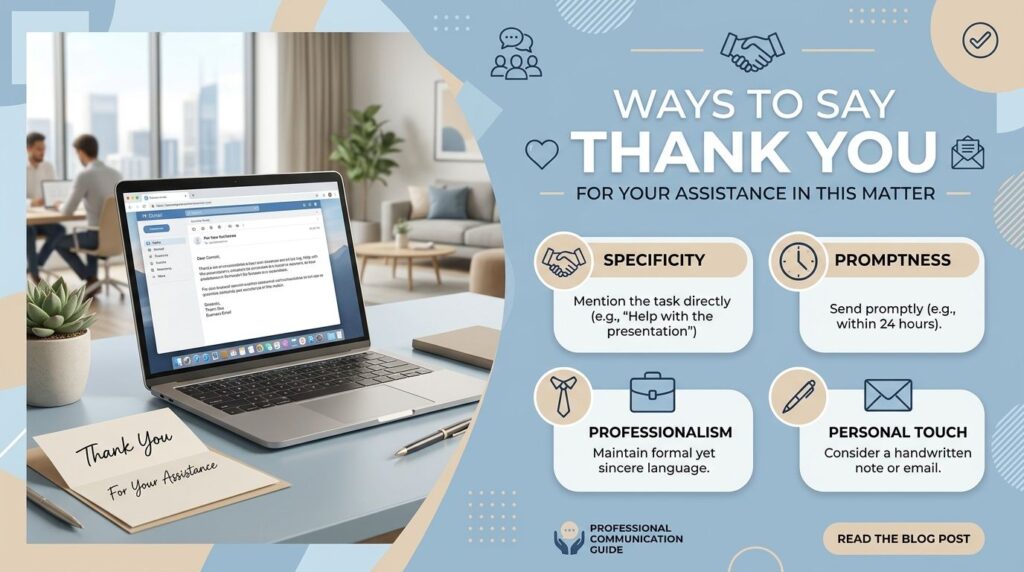
Ways to Say “Thank You for Your Assistance in This Matter” (40+ Professional Alternatives)
You’ve received help. Someone resolved an issue, answered a request, or stepped up when it mattered — and now you need to acknowledge it. The phrase “thank you for your assistance in this matter” is a classic go-to, but let’s be honest: it shows up in so many professional emails that it barely registers anymore.
The good news? You don’t need to reinvent the wheel — you just need the right alternatives. Whether you’re writing a business email, a formal letter, a client follow-up, or a quick internal message, this guide gives you 40+ polished, context-specific ways to express genuine gratitude without sounding like a corporate template.
What Does “Thank You for Your Assistance in This Matter” Mean?
This phrase is a formal expression of gratitude used when someone has helped you with a specific task, issue, or request. It’s widely used in professional emails, legal correspondence, administrative communication, and client-facing messages.
It conveys three things at once: respect for the person’s time, acknowledgment of their contribution, and closure on the matter at hand. That’s why it works so well — but also why it can feel hollow when overused. A more specific or tailored phrase does all of this and actually lands.
Why Varying Your Gratitude Language Matters
Research in workplace psychology consistently shows that employees and clients who feel genuinely appreciated are more engaged, loyal, and productive. Generic phrases don’t build that feeling — thoughtful ones do.
When you use varied, sincere language to express appreciation, you:
- Build stronger professional relationships over time
- Come across as emotionally intelligent and self-aware
- Stand out in inboxes full of identical corporate phrasing
- Reflect well on your communication skills and professionalism
The right words aren’t just polite — they’re strategic.
Professional Ways to Say “Thank You for Your Assistance in This Matter”
Formal Alternatives (For Business Emails and Official Correspondence)
These phrases are polished and appropriate for corporate settings, legal writing, HR communications, and any context where a high level of professionalism is expected.
| Phrase | Tone | Best Used For |
|---|---|---|
| I appreciate your assistance with this request | Formal, direct | Business emails, follow-ups |
| I’m grateful for your assistance in resolving this | Respectful, sincere | Issue resolution, client messages |
| Thank you for your cooperation in this matter | Formal, collaborative | Legal, administrative, HR contexts |
| Your support throughout this process is appreciated | Warm, professional | Long-term projects, partnerships |
| I sincerely thank you for your assistance | Highly formal, respectful | Official letters, formal correspondence |
| Your help in addressing this matter is greatly appreciated | Polished, specific | Problem-resolution emails |
| Thank you for your efforts in handling this | Acknowledging, professional | Team communication, leadership messages |
Example in context:
“Dear Ms. Chen, I sincerely thank you for your assistance in reviewing the contract terms. Your input was both thorough and timely, and it made all the difference in moving this forward.”
Warm Professional Alternatives (For Colleagues and Team Members)
These strike a balance between professional respect and genuine human warmth. They’re ideal for internal emails, team messages, and situations where you have an established working relationship.
- “Your help truly made a difference here” — Specific, sincere, and impossible to mistake for filler.
- “I appreciate your support throughout this process“ — Great for ongoing projects or collaborative efforts.
- “Many thanks for your help on this” — Polite and friendly without being overly casual.
- “Thank you for stepping in and handling this.” — Acknowledges that they took initiative, which adds weight.
- “I’m thankful for your involvement in getting this resolved” — Recognizes both the effort and the outcome.
- “Your assistance has been invaluable” — Strong and sincere. Use this when the help was genuinely significant.
- “Thanks for your attention to this matter.” — Clean, professional, and efficient. Works well as a brief email closer.
Alternatives That Highlight Specific Qualities
One of the most effective ways to express gratitude is to name what you’re thankful for — the speed, the expertise, the effort. These phrases do exactly that.
For speed and responsiveness:
- “I appreciate your prompt response to this issue.”
- “Thank you for addressing this so quickly.”
- “Your responsiveness on this matter has been excellent.”
For expertise and guidance:
- “Your guidance on this has been incredibly helpful.”
- “Thank you for your expert input in resolving this.”
- “I’m grateful for the insight you brought to this matter.”
For going above and beyond:
- “I truly appreciate the effort you put into this.”
- “Thank you for going above and beyond to help with this.”
- “Your dedication in handling this has not gone unnoticed.”
For collaboration:
- “Thank you for your cooperation and support on this.”
- “I appreciate your involvement and input throughout.”
- “Working through this with your support made it so much smoother.”
Short and Concise Alternatives (For Email Closings and Quick Messages)
Sometimes you need something brief and clean — a closing line, a short reply, or a quick acknowledgment. These work without feeling abrupt.
- Much appreciated — thank you
- Your help is greatly appreciated
- Thanks so much for handling this
- I really appreciate your help here
- Thank you — this means a lot
- Grateful for your support on this
- Your assistance is truly valued
These work especially well as sign-offs in professional emails when you want to close on a note of genuine appreciation without over-elaborating.
Heartfelt Alternatives (For Significant Help or Meaningful Support)
When someone went out of their way — worked late, solved a major problem, or supported you through something difficult — a routine thank-you simply doesn’t do it justice. These phrases carry more weight.
- “I can’t thank you enough for your help with this” — Expressive without being over the top. Warm and sincere.
- “I want to express my genuine gratitude for your assistance” — Formal and heartfelt. Good for written correspondence.
- “Your support during this has meant more than I can say” — Use this when the help had a real personal or professional impact.
- “I truly appreciate the time and effort you gave to this matter” — Acknowledges both the investment and the person behind it.
- “Your kindness in assisting with this has not gone unnoticed” — Warm and appreciative of both the act and the attitude.
How to Choose the Right Phrase
Picking the best alternative isn’t just about avoiding repetition — it’s about matching the message to the moment. Here’s how to think it through:
1. Consider the level of formality. A message to a government official or legal contact needs a different register than a message to a colleague you see every day.
2. Match the scale of the help. Someone who sent a quick clarification email deserves a clean, brief thank-you. Someone who spent three days resolving a complex issue deserves something more substantial and specific.
3. Use the platform as your guide. Email sign-offs, LinkedIn messages, internal Slack notes, and formal letters each have their own tone. What fits one doesn’t always fit another.
4. Add specificity whenever you can. The single most effective upgrade to any thank-you is mentioning what they did. “I appreciate your assistance” is good. “I appreciate the time you took to review those contracts before the deadline” is significantly better.
Quick Reference: Phrase by Context
| Context | Best Phrase |
|---|---|
| Business email to a client | “Thanks for stepping in and handling this so smoothly.” |
| Internal email to a colleague | “I sincerely thank you for your cooperation in this matter.” |
| Legal or administrative letter | “Your guidance has been invaluable — thank you sincerely.” |
| Thanking a supervisor | “I appreciate your prompt response and quick resolution.” |
| Responding to the prompt helps | “I’m truly grateful for your insight and support on this.” |
| Thanking a mentor or advisor | “Thank you all for your efforts and cooperation throughout this.” |
| Group email to a team | Responding to the prompt help |
Common Mistakes to Avoid
- Repeating the exact same phrase in consecutive emails. If you’ve already written “thank you for your assistance in this matter” once this week to the same person, it’s time to vary it.
- Using heartfelt language for minor requests. Saying “I can’t thank you enough” for a two-line email response can come across as disproportionate and even insincere.
- Going too casual in formal settings. “Thanks a ton” might work in a team Slack channel but not in a client-facing message or legal correspondence.
- Forgetting to be specific. The phrase you choose matters, but what matters even more is pairing it with a brief mention of what you’re actually thanking them for.
Frequently Asked Questions
Is “thank you for your assistance in this matter” too formal?
It’s professional and polite, but it can feel generic. A more specific alternative often sounds warmer and more genuine.
Can I use these phrases in professional emails?
Yes — most of these alternatives are specifically designed for professional emails and business correspondence.
What’s the difference between “assistance” and “help” in these phrases?
“Assistance” is more formal and suits official or corporate communication. “Help” is slightly more casual and works well in internal or semi-formal messages.
How do I make a thank-you message feel more sincere?
Add a specific detail — what they did, how it helped, or what it made possible. That one addition transforms a routine phrase into something memorable.
Is “your assistance is greatly appreciated” correct to use?
Yes, it’s grammatically correct and widely used in professional communication. It works best as a closing line in formal emails.
Can I use these phrases in legal correspondence?
Phrases like “I sincerely thank you for your cooperation in this matter” or “your assistance has been invaluable” are both appropriate for legal and administrative contexts.
What’s a good one-line thank-you for a quick email reply?
“Much appreciated — thank you” or “Thanks for addressing this so promptly” both work well as clean, brief closings.
Final Thoughts
The phrase “thank you for your assistance in this matter” is correct, professional, and perfectly acceptable — but it shouldn’t be your only tool. The way you express gratitude shapes how people perceive you, and in professional settings, those perceptions genuinely matter.
You don’t need elaborate language. You need the right language. Choose a phrase that fits the situation, add a specific detail where you can, and your message will land exactly the way you intend it to. Just like learning professional ways to say goodbye in your future endeavors can improve the tone of your farewell messages, using thoughtful thank-you phrases strengthens workplace communication and relationships. A well-chosen thank-you isn’t just courtesy — it’s communication that builds real professional trust.

Shoaib Ahmed is a passionate content writer and language enthusiast who specializes in simplifying complex words, slang, and abbreviations into easy-to-understand meanings. As the creator of MeanFind.com, he is dedicated to helping readers quickly find clear and accurate definitions without confusion.