
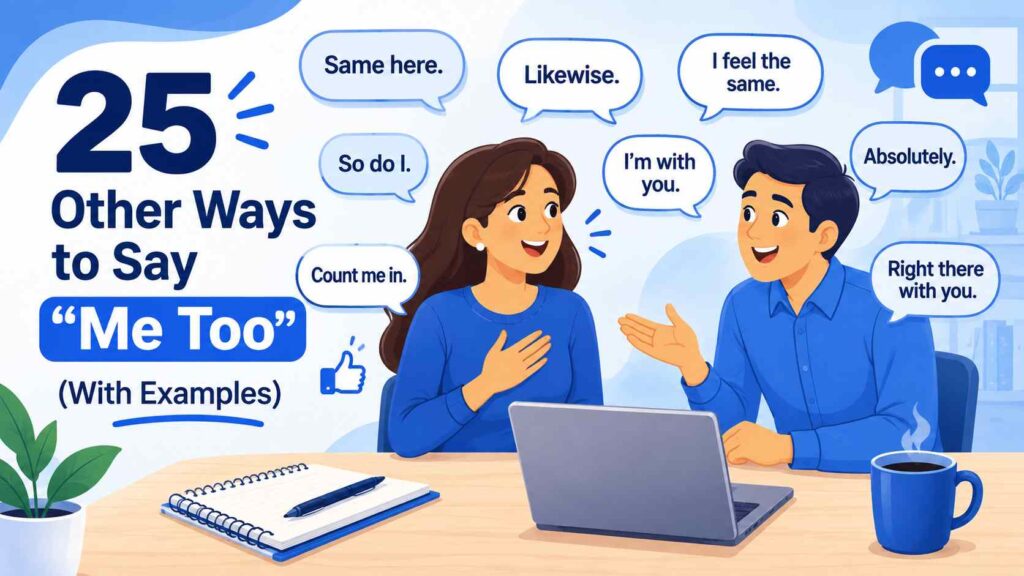
Someone shares something personal, exciting, or exhausting, and the first word that comes to mind is “me too.” It’s quick, it’s honest, and it instantly signals connection — but say it enough times and it starts to feel like a placeholder rather than a real response. If you want your reactions to feel more genuine, more specific, or better suited to the moment, there’s a whole range of alternatives to me too waiting to be used. This guide breaks down 25 fresh ways to say me too, complete with meanings, examples, and the right context for each one.
What Does “Me Too” Mean?
“Me too” is a short phrase used to express agreement, shared experience, or emotional connection with what someone else has just said. It essentially means “I feel or experience the same thing.” The phrase works in almost any casual conversation, whether someone is sharing good news, venting about a bad day, or simply stating a preference.
When to Use “Me Too”
“Me too” fits naturally into everyday conversation, especially when:
- Someone shares a feeling, experience, or opinion you genuinely share.
- You want to show quick, casual support or agreement.
- The conversation is informal — texting, chatting with friends, or light social exchanges.
- You’re validating someone’s experience without needing to explain further.
It’s less suited to formal writing, professional emails, or situations where a more detailed response would show deeper engagement.
Is It Professional/Polite to Say “Me Too”?
“Me too” is perfectly polite in casual and semi-formal settings, but it can come across as underwhelming in professional communication. In a workplace email or client conversation, a short “me too” might read as dismissive or lazy, even if that’s not the intent. In those cases, a fuller alternative — like “I share that same experience” or “I can relate to that” — tends to land better and shows more thoughtful engagement.
Pros and Cons of Saying “Me Too”
| Pros | Cons |
|---|---|
| Quick and easy to say | Can feel repetitive if overused |
| Shows immediate connection | May seem dismissive in formal settings |
| Widely understood across contexts | Lacks detail or personalization |
| Works well in casual conversation | Doesn’t always convey depth of empathy |
Synonyms of “Me Too”
Some quick, simple substitutes for me too include: same here, I relate, I know the feeling, likewise, and I’ve been there. These work as short, casual swaps, while the 25 alternatives below offer more nuance depending on the tone and setting you need.
I Feel the Same Way
Meaning: A warm, personal way to express shared emotion or opinion.
Example: “I feel the same way about working from home — it’s been a big adjustment.”
Best Use: Personal conversations, emotional support.
Worst Use: Very formal business writing.
Tone: Warm, sincere, relatable.
I Can Relate
Meaning: A common, conversational phrase showing personal connection to someone’s experience.
Example: “I can relate — I went through something similar last year.”
Best Use: Everyday conversations, casual support.
Worst Use: Highly formal or legal communication.
Tone: Friendly, understanding, casual.
Same Here
Meaning: A short, casual way to confirm shared experience or opinion.
Example: “Same here — I haven’t had coffee yet either.”
Best Use: Texting, informal chats.
Worst Use: Professional emails or formal writing.
Tone: Casual, brief, friendly.
I Share Your Sentiment
Meaning: A formal way to express agreement with someone’s feelings or opinion.
Example: “I share your sentiment regarding the new policy changes.”
Best Use: Formal emails, professional discussions.
Worst Use: Casual texting or informal chats.
Tone: Formal, respectful, composed.
I’ve Been There Too
Meaning: Expresses shared past experience, often used for empathy.
Example: “I’ve been there too — job interviews are always nerve-wracking.”
Best Use: Supportive, empathetic conversations.
Worst Use: Formal written reports.
Tone: Empathetic, warm, personal.
I Understand Completely
Meaning: A reassuring phrase showing full comprehension and shared feeling.
Example: “I understand completely — balancing work and family isn’t easy.”
Best Use: Emotional support, sensitive conversations.
Worst Use: Quick, casual exchanges.
Tone: Reassuring, sincere, thoughtful.
I Know That Feeling
Meaning: A relatable phrase acknowledging a specific emotional experience.
Example: “I know that feeling — Mondays are always the hardest.”
Best Use: Casual conversations, friendly support.
Worst Use: Formal business correspondence.
Tone: Casual, relatable, warm.
I Feel That Too
Meaning: A simple, direct way to confirm a shared emotional response.
Example: “I feel that too — this project has been exhausting.”
Best Use: Everyday conversations, team chats.
Worst Use: Formal presentations or reports.
Tone: Direct, sincere, casual.
I’ve Experienced That Too
Meaning: A slightly more detailed way to confirm a shared past experience.
Example: “I’ve experienced that too, especially during my first year at the company.”
Best Use: Personal storytelling, mentoring conversations.
Worst Use: Short, quick replies.
Tone: Reflective, personal, warm.
That Happens to Me As Well
Meaning: A neutral, slightly formal way to confirm a shared occurrence.
Example: “That happens to me as well when I skip breakfast.”
Best Use: Semi-formal conversations, workplace chats.
Worst Use: Highly casual texting.
Tone: Neutral, polite, composed.
I’m With You on That
Meaning: Shows agreement and solidarity with someone’s opinion or feeling.
Example: “I’m with you on that — the new schedule is too tight.”
Best Use: Team discussions, casual agreement.
Worst Use: Formal legal or contractual writing.
Tone: Supportive, friendly, direct.
I Get That
Meaning: A brief, modern way to show understanding or shared experience.
Example: “I get that — deadlines always sneak up faster than expected.”
Best Use: Casual conversations, workplace chats.
Worst Use: Formal written documents.
Tone: Casual, relaxed, understanding.
I Can Understand That
Meaning: A polite, slightly formal way to express empathy or shared perspective.
Example: “I can understand that — change is never easy to adjust to.”
Best Use: Semi-formal conversations, workplace support.
Worst Use: Very casual, quick exchanges.
Tone: Polite, thoughtful, composed.
I Relate to That
Meaning: A conversational phrase expressing personal connection to a statement.
Example: “I relate to that — public speaking makes me nervous too.”
Best Use: Personal conversations, casual support.
Worst Use: Formal professional writing.
Tone: Relatable, warm, casual.
I’m In the Same Boat
Meaning: An idiom expressing that you’re facing the same situation as someone else.
Example: “I’m in the same boat — juggling three projects at once.”
Best Use: Casual workplace or personal conversations.
Worst Use: Formal business documents.
Tone: Relatable, casual, friendly.
I’ve Felt That Too
Meaning: Confirms a shared emotional experience from the past.
Example: “I’ve felt that too, especially when starting something new.”
Best Use: Emotional support, personal sharing.
Worst Use: Quick, transactional replies.
Tone: Empathetic, personal, sincere.
I Understand How You Feel
Meaning: A compassionate phrase showing deep empathy toward someone’s emotional state.
Example: “I understand how you feel — losing a pet is never easy.”
Best Use: Sensitive, emotional conversations.
Worst Use: Light, casual small talk.
Tone: Compassionate, sincere, warm.
That’s True for Me Too
Meaning: A neutral way to confirm that a statement applies to you as well.
Example: “That’s true for me too — mornings are definitely my slow start.”
Best Use: Everyday conversations, casual agreement.
Worst Use: Formal presentations.
Tone: Neutral, casual, direct.
I Can See That Too
Meaning: Shows agreement by acknowledging a shared perspective or observation.
Example: “I can see that too — the new layout does feel more efficient.”
Best Use: Discussions, casual feedback.
Worst Use: Highly emotional or sensitive topics.
Tone: Observational, neutral, agreeable.
I’m Aligned With That
Meaning: A formal, workplace-friendly way to express agreement.
Example: “I’m aligned with that — the revised timeline makes more sense.”
Best Use: Professional meetings, business emails.
Worst Use: Casual personal conversations.
Tone: Formal, professional, composed.
I Have the Same Experience
Meaning: A clear, straightforward way to confirm a shared past experience.
Example: “I have the same experience with long commutes affecting my mood.”
Best Use: Personal or semi-formal conversations.
Worst Use: Quick, casual texting.
Tone: Sincere, clear, relatable.
I Am Experiencing That Too
Meaning: Confirms a currently shared situation or feeling.
Example: “I am experiencing that too — the new system has a learning curve.”
Best Use: Workplace discussions, ongoing situations.
Worst Use: Past, one-time experiences.
Tone: Present-focused, sincere, neutral.
I’m on the Same Page
Meaning: An idiom expressing agreement or shared understanding.
Example: “I’m on the same page — let’s move forward with that plan.”
Best Use: Team discussions, decision-making conversations.
Worst Use: Emotional or personal support situations.
Tone: Confident, agreeable, professional.
I Have Felt the Same Way
Meaning: A reflective phrase confirming a previously shared emotional state.
Example: “I have felt the same way after a long week of back-to-back meetings.”
Best Use: Personal reflection, supportive conversations.
Worst Use: Brief, casual exchanges.
Tone: Reflective, sincere, warm.
I Stand With You
Meaning: A supportive, solidarity-focused phrase showing shared stance or belief.
Example: “I stand with you on this decision — it’s the right call.”
Best Use: Support in difficult situations, showing solidarity.
Worst Use: Light, casual small talk.
Tone: Supportive, strong, sincere.
Final Thoughts
“Me too” will always be a quick, honest way to show connection, but it isn’t the only option — and it isn’t always the best one. From casual replies like “same here” to more supportive phrases like “I stand with you,” these 25 alternatives let you match your response to the emotional weight of the moment. Just as picking the right words to say me too can strengthen a conversation, so can expressing gratitude the right way — the same intentionality behind a phrase like Thank You For Making This Happen applies here too.
FAQs
What does “me too” mean?
“Me too” means you share the same feeling, experience, or opinion as the person you’re speaking with.
When should I say “me too”?
Use it in casual, informal conversations to quickly show agreement or shared experience.
Is “me too” professional?
It’s fine in casual workplace chats, but formal settings usually call for a fuller alternative.
Can “me too” be used in writing?
Yes, though in professional writing, a more detailed alternative often reads better.
What are casual alternatives to “me too”?
“Same here,” “I get that,” and “I’m in the same boat” all work well casually.
What are formal alternatives?
“I share your sentiment” and “I’m aligned with that” suit professional or formal contexts.
How does tone affect “me too”?
The right alternative should match whether the moment calls for warmth, formality, or brevity.
Can “me too” express emotional support?
Yes, especially when paired with phrases like “I understand how you feel” for added depth.
How do I make “me too” more personal?
Add specific details, like referencing your own similar experience, instead of a one-word reply.
Are there risks in overusing “me too”?
Yes, repeating it too often can make responses feel automatic rather than genuine.
Can “me too” be used in group settings?
Yes, it works well for quickly showing shared agreement among multiple people.
Does “me too” always indicate agreement?
Usually, though it can also simply confirm a shared experience rather than an opinion.
How can “me too” improve relationships?
It signals empathy and connection, which helps build trust and rapport over time.
Is “me too” universal across cultures?
The sentiment is universal, though the exact phrasing and appropriateness can vary by culture.
How can I choose the best alternative?
Match the phrase to the setting — casual, formal, or emotional — and the depth of connection you want to show.

Shoaib Ahmed is a passionate content writer and language enthusiast who specializes in simplifying complex words, slang, and abbreviations into easy-to-understand meanings. As the creator of MeanFind.com, he is dedicated to helping readers quickly find clear and accurate definitions without confusion.