
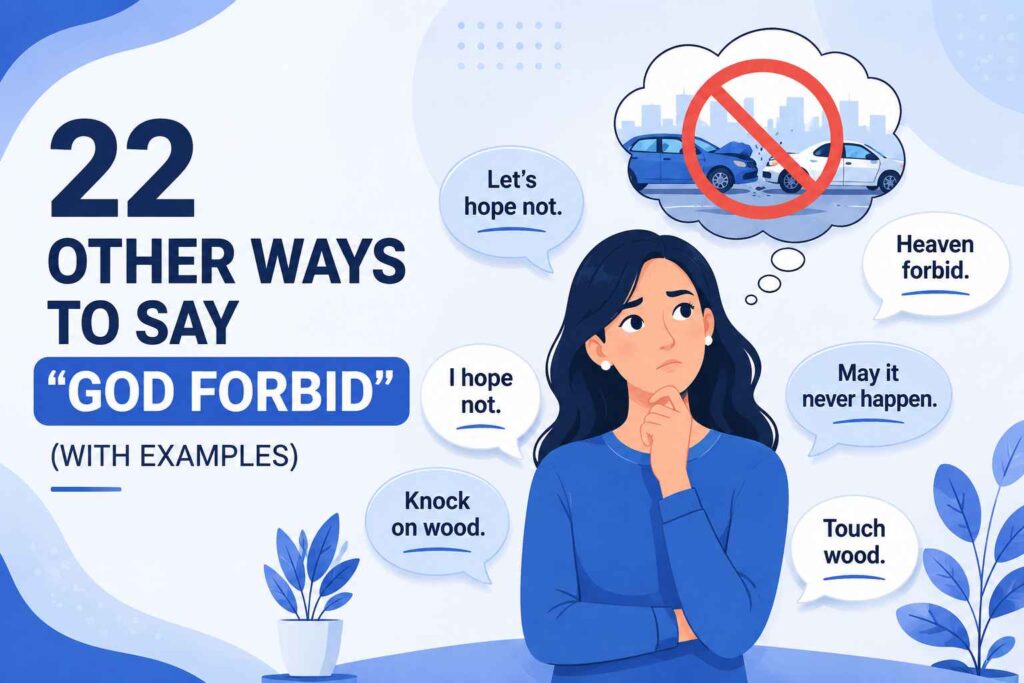
There’s a specific kind of dread behind the phrase “God forbid” — that instinctive wish that something terrible never happens. But say it too often, in too many contexts, and it starts to lose its weight, or worse, it feels out of place in a professional email or a casual text with a friend. The truth is, English has plenty of other ways to express that same mix of fear, hope, and superstition, each suited to a different tone and setting. Below are 22 alternatives to God forbid, complete with meanings, examples, and clear guidance on where each one fits best.
Why Find Alternatives to “God Forbid”?
“God forbid” carries strong religious and cultural weight, which makes it perfect in some settings and awkward in others.
Using a different phrase can help you:
- Match the tone of religious, secular, formal, or casual conversations.
- Avoid sounding repetitive when the worry comes up more than once.
- Keep professional writing neutral where religious phrasing feels out of place.
- Add variety and emotional nuance to everyday speech.
Whether you’re writing fiction, chatting with friends, or simply trying to avoid overusing the same expression, there’s an alternative to God forbid for nearly every situation below.
Formal and Neutral Alternatives
These options work well in professional writing, journalism, or contexts where a religious phrase feels out of place.
1. Heaven Forbid
Meaning: A softer, spiritual version of “God forbid,” expressing strong hope that something won’t happen.
Example: “Heaven forbid you ever get hurt on the way home.”
Best Use: When showing deep care or fear for someone’s safety.
Worst Use: In professional writing or business emails.
Tone: Concerned, heartfelt, spiritual.
2. Hopefully Not
Meaning: A plain, neutral way to express hope that a bad outcome won’t occur.
Example: “Hopefully not, but the storm could knock out power for days.”
Best Use: Everyday conversation, casual writing, professional emails.
Worst Use: Dramatic or emotionally charged storytelling.
Tone: Neutral, calm, practical.
3. In the Worst-Case Scenario
Meaning: A formal, analytical phrase used to introduce a possible negative outcome without emotional framing.
Example: “In the worst-case scenario, the shipment could be delayed by two weeks.”
Best Use: Business reports, risk assessments, planning documents.
Worst Use: Casual or emotional conversations.
Tone: Formal, analytical, neutral.
4. Should the Worst Happen
Meaning: A formal conditional phrase used to acknowledge a bad possibility while staying composed.
Example: “Should the worst happen, the backup generator will kick in automatically.”
Best Use: Legal documents, technical writing, contingency planning.
Worst Use: Light, everyday chit-chat.
Tone: Formal, composed, precise.
5. Let’s Hope That Never Happens
Meaning: A direct, straightforward wish against a negative outcome.
Example: “Let’s hope that never happens, but we should still have a backup plan.”
Best Use: Team discussions, planning conversations.
Worst Use: Highly formal legal or academic writing.
Tone: Neutral, hopeful, practical.
6. Touch Wood
Meaning: A superstitious phrase used to ward off bad luck after mentioning something positive.
Example: “We’ve had no issues so far — touch wood.”
Best Use: Casual conversation, especially in British English.
Worst Use: Formal or written business communication.
Tone: Superstitious, casual, light.
7. Knock on Wood
Meaning: The American equivalent of “touch wood,” used to avoid tempting fate.
Example: “The car’s been running fine all year — knock on wood.”
Best Use: Casual American English conversations.
Worst Use: Formal writing or professional emails.
Tone: Superstitious, casual, familiar.
8. Fingers Crossed That Doesn’t Happen
Meaning: A hopeful, slightly informal way to express a wish against a negative outcome.
Example: “Fingers crossed that doesn’t happen before the deadline.”
Best Use: Casual conversations, texts, informal emails.
Worst Use: Formal legal or academic contexts.
Tone: Hopeful, casual, warm.
Religious and Cultural Alternatives
These phrases carry spiritual or cultural weight similar to the original expression.
9. Inshallah, Not
Meaning: Combines a common expression of hope with divine will, often used in Muslim-majority cultures.
Example: “Inshallah, not, but if the surgery is needed, we’ll be ready.”
Best Use: Conversations within cultures where the phrase is commonly used.
Worst Use: Formal English business writing.
Tone: Spiritual, hopeful, culturally specific.
10. God Willing, It Won’t Come to That
Meaning: Expresses hope while acknowledging a higher power’s role in the outcome.
Example: “God willing, it won’t come to that, but we’ve prepared just in case.”
Best Use: Religious or faith-based conversations.
Worst Use: Secular professional writing.
Tone: Spiritual, hopeful, reverent.
11. May It Never Come to Pass
Meaning: A poetic, almost biblical way of expressing a strong wish against something happening.
Example: “May it never come to pass, but the family has already made arrangements.”
Best Use: Formal speeches, literary or religious writing.
Worst Use: Casual texting or everyday chat.
Tone: Formal, solemn, poetic.
12. Perish the Thought
Meaning: A dramatic, slightly old-fashioned way of dismissing an unwanted possibility.
Example: “Perish the thought that we’d have to cancel the wedding.”
Best Use: Expressive writing, dramatic conversation, storytelling.
Worst Use: Straightforward business communication.
Tone: Dramatic, expressive, old-fashioned.
13. Heaven Help Us If
Meaning: A dramatic, slightly humorous phrase implying trouble if something occurs.
Example: “Heaven help us if the printer breaks down again before the deadline.”
Best Use: Light-hearted warnings among friends or coworkers.
Worst Use: Serious formal writing.
Tone: Dramatic, humorous, informal.
14. Bite Your Tongue
Meaning: An idiom used to tell someone to stop speaking about an unwanted possibility, as if speaking it aloud could make it happen.
Example: “Don’t even say that — bite your tongue!”
Best Use: Casual, superstitious conversations.
Worst Use: Professional or written communication.
Tone: Playful, superstitious, informal.
Casual and Conversational Alternatives
Perfect for everyday speech, texting, and informal writing.
15. Let’s Not Even Think About That
Meaning: A conversational way to dismiss a negative possibility without dwelling on it.
Example: “Let’s not even think about that happening before the trip.”
Best Use: Casual conversations, friendly reassurance.
Worst Use: Formal risk assessments.
Tone: Casual, reassuring, light.
16. I Really Hope Not
Meaning: A simple, sincere expression of hope against a negative outcome.
Example: “I really hope not, but the tests might come back positive.”
Best Use: Personal conversations, emotional support.
Worst Use: Formal legal writing.
Tone: Sincere, casual, warm.
17. Cross My Fingers That Never Happens
Meaning: A playful, hopeful phrase used to express a wish against bad luck.
Example: “I’ll cross my fingers that never happens during the event.”
Best Use: Light, informal conversations.
Worst Use: Serious professional documents.
Tone: Playful, hopeful, casual.
18. Not on My Watch
Meaning: A confident, protective phrase implying the speaker will actively prevent a bad outcome.
Example: “Not on my watch — I’ll make sure that never happens.”
Best Use: Reassuring someone, confident conversations.
Worst Use: Passive or neutral formal writing.
Tone: Confident, protective, assertive.
19. That Would Be a Nightmare
Meaning: An informal way to express how undesirable a possible outcome would be.
Example: “Losing the files now would be a nightmare — let’s back everything up.”
Best Use: Everyday conversation, informal writing.
Worst Use: Formal reports or academic writing.
Tone: Casual, expressive, relatable.
20. I Shudder to Think
Meaning: A vivid, emotional phrase expressing discomfort at the thought of something bad happening.
Example: “I shudder to think what would happen if we missed that deadline.”
Best Use: Expressive writing, storytelling, personal conversations.
Worst Use: Neutral technical documents.
Tone: Emotional, vivid, expressive.
21. Let’s Hope It Doesn’t Come to That
Meaning: A calm, hopeful phrase used when discussing a possible negative outcome.
Example: “Let’s hope it doesn’t come to that, but we should have a plan B.”
Best Use: Planning conversations, cautious optimism.
Worst Use: Overly dramatic storytelling.
Tone: Calm, hopeful, practical.
22. Pray That Never Happens
Meaning: A faith-based phrase expressing a heartfelt wish against a negative outcome.
Example: “We pray that never happens, but the doctors are prepared either way.”
Best Use: Religious or emotionally significant conversations.
Worst Use: Secular business communication.
Tone: Spiritual, sincere, heartfelt.
23. Not to Jinx It, But
Meaning: A superstitious phrase used before mentioning something good, to avoid tempting fate.
Example: “Not to jinx it, but the project has been going smoothly all month.”
Best Use: Casual conversations about ongoing good luck.
Worst Use: Formal written reports.
Tone: Superstitious, casual, light-hearted.
Quick Reference Table
| Category | Example Phrase | Best For | Tone |
|---|---|---|---|
| Formal/Neutral | Should the Worst Happen | Business, legal writing | Formal |
| Religious/Cultural | May It Never Come to Pass | Faith-based conversations | Spiritual |
| Casual | Not on My Watch | Everyday conversation | Confident |
| Superstitious | Knock on Wood | Informal chat | Playful |
Conclusion
“God forbid” is a powerful phrase, but it isn’t the only way to express that instinctive hope against bad news. From formal alternatives like “should the worst happen” to casual ones like “fingers crossed that doesn’t happen,” these 22 options let you match your tone to the moment instead of repeating the same expression every time. And just like choosing the right words for a difficult possibility matters, so does choosing the right words for good news — the same care you’d put into saying we are pleased to inform you applies here too.
FAQs
Is “God Forbid” religious or can it be used casually?
It originated as a religious expression, but it’s now widely used casually in everyday English, regardless of faith.
What’s a non-religious alternative to “God Forbid”?
“Hopefully not” or “let’s hope that never happens” are neutral, secular alternatives suited for professional settings.
Is “Knock on Wood” the same as “God Forbid”?
They’re similar in intent but different in origin — “knock on wood” is superstitious, while “God forbid” is religious.
Can “God Forbid” be used in formal writing?
It’s best avoided in formal or business writing; phrases like “should the worst happen” work better in that context.
What’s a more dramatic alternative to “God Forbid”?
“Perish the thought” or “I shudder to think” both carry a stronger, more expressive tone.

Shoaib Ahmed is a passionate content writer and language enthusiast who specializes in simplifying complex words, slang, and abbreviations into easy-to-understand meanings. As the creator of MeanFind.com, he is dedicated to helping readers quickly find clear and accurate definitions without confusion.