
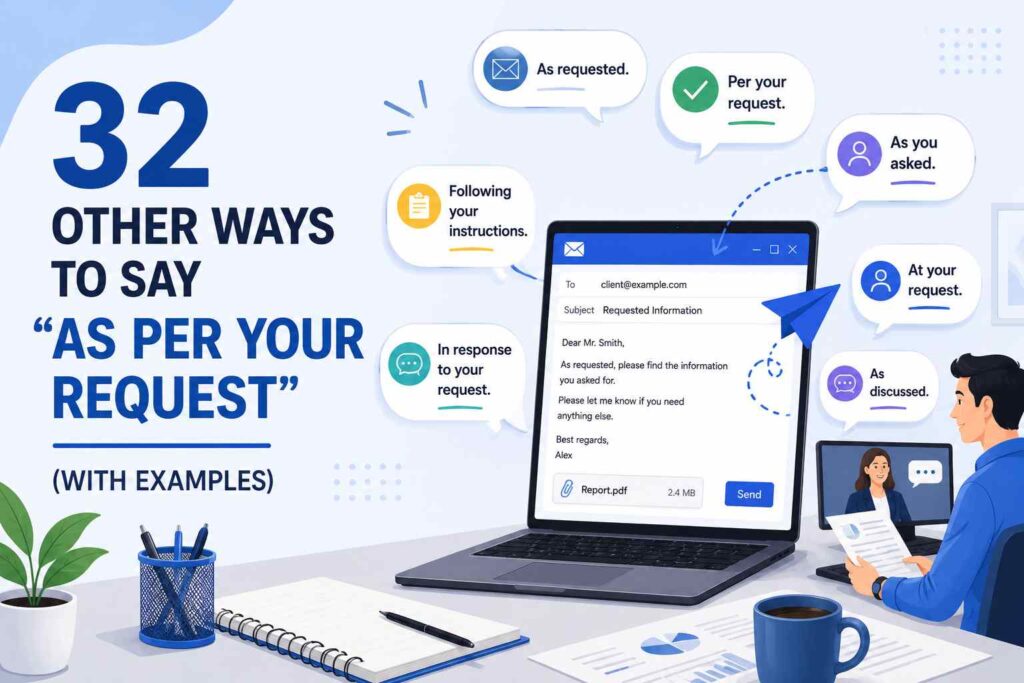
Type “as per your request” one more time and you might start wondering if your emails sound like they’re written by a template instead of a person. It’s a phrase that gets the job done, but it’s also stiff, overused, and honestly a little cold for how much business communication actually happens today. The good news? There are dozens of better ways to say the same thing some warmer, some more formal, some just plain clearer. Below are 32 fresh alternatives to as per your request, each with a clear meaning, a real-world example, and guidance on exactly when to use it.
Why Replace “As Per Your Request”?
“As per your request” is grammatically fine, but it’s also one of the most overused phrases in business writing. It can come across as robotic, especially in emails meant to build a relationship.
Choosing a better alternative helps you:
- Sound more natural and less like a copy-paste template.
- Match the tone of the message, whether formal, friendly, or urgent.
- Avoid repeating the same phrase across multiple emails to the same person.
- Make routine responses feel more considered and personal.
Whether you’re replying to a client, updating a colleague, or confirming a customer’s order, there’s a stronger alternative to as per your request in the list below.
Formal and Professional Alternatives
Best suited for official emails, client communication, and business correspondence.
1. As You Requested
Meaning: A slightly shorter, more natural version of the original formal phrase.
Example: “As you requested, I’ve updated the report with the latest figures.”
Best Use: Formal client or manager emails.
Worst Use: Very casual internal chats.
Tone: Formal, direct.
2. Per Your Request
Meaning: A concise, business-standard alternative that trims the phrase down.
Example: “Per your request, the invoice has been resent to your billing email.”
Best Use: Quick formal confirmations.
Worst Use: Warm, relationship-building emails.
Tone: Formal, efficient.
3. In Response to Your Request
Meaning: A formal phrase that clearly frames the message as a direct reply.
Example: “In response to your request, please find the updated contract attached.”
Best Use: Official replies, formal follow-ups.
Worst Use: Casual internal updates.
Tone: Formal, structured.
4. Further to Your Request
Meaning: A traditional, slightly British-leaning phrase used to continue a prior conversation.
Example: “Further to your request, we’ve scheduled the site visit for next Tuesday.”
Best Use: Formal UK business correspondence.
Worst Use: American casual workplace emails.
Tone: Formal, traditional.
5. As Discussed and Requested
Meaning: Combines a reference to a prior conversation with confirmation of action taken.
Example: “As discussed and requested, I’ve forwarded the proposal to the finance team.”
Best Use: Follow-ups after meetings or calls.
Worst Use: First-contact or cold emails.
Tone: Formal, confirming.
6. In Accordance with Your Request
Meaning: A highly formal phrase often used in legal or official documentation.
Example: “In accordance with your request, the records have been updated accordingly.”
Best Use: Legal, compliance, or HR communication.
Worst Use: Everyday team emails.
Tone: Formal, precise.
7. As Per Our Conversation
Meaning: A close variant that references a spoken exchange rather than a written request.
Example: “As per our conversation, I’ve included the revised timeline below.”
Best Use: Follow-ups after calls or meetings.
Worst Use: Emails where no prior conversation occurred.
Tone: Formal, referential.
8. Following Your Request
Meaning: A clean, formal alternative that signals action taken after a request.
Example: “Following your request, the account has been upgraded to premium access.”
Best Use: Confirmation emails, account updates.
Worst Use: Casual, unsolicited messages.
Tone: Formal, procedural.
9. At Your Request
Meaning: A short, formal phrase emphasizing that the action was specifically requested.
Example: “At your request, we’ve extended the deadline by one week.”
Best Use: Approvals, extensions, formal confirmations.
Worst Use: Informal peer-to-peer chats.
Tone: Formal, respectful.
10. As Requested by You
Meaning: A slightly more explicit variation that clearly attributes the request to the recipient.
Example: “As requested by you, the meeting has been moved to 3 PM.”
Best Use: Formal scheduling or logistics emails.
Worst Use: Casual conversations.
Tone: Formal, clear.
Professional Email-Specific Alternatives
Ideal for the opening or body of a business email confirming action on a request.
11. Please Find Below as Requested
Meaning: A formal lead-in used to introduce information provided in response to a request.
Example: “Please find below as requested the updated pricing for your order.”
Best Use: Detailed email replies with information included in the body.
Worst Use: Emails involving attached files instead of body content.
Tone: Formal, informative.
12. Attached Is What You Asked For
Meaning: A direct, semi-formal phrase confirming a requested file has been sent.
Example: “Attached is what you asked for — let me know if you need anything else.”
Best Use: Quick professional replies with attachments.
Worst Use: Highly formal legal correspondence.
Tone: Professional, friendly.
13. I’ve Prepared This as You Asked
Meaning: A warm, professional phrase that emphasizes effort put into fulfilling the request.
Example: “I’ve prepared this as you asked, along with a few extra notes for context.”
Best Use: Detailed reports, custom requests.
Worst Use: Simple, one-line confirmations.
Tone: Professional, thoughtful.
14. As You Asked, I’ve Included
Meaning: A conversational way to confirm specific information was added per the request.
Example: “As you asked, I’ve included the revised figures in the second tab.”
Best Use: Spreadsheet or document-based emails.
Worst Use: Verbal or in-person communication.
Tone: Professional, clear.
15. To Address Your Request
Meaning: A formal phrase framing the message as a direct solution to the recipient’s ask.
Example: “To address your request, we’ve adjusted the billing cycle starting next month.”
Best Use: Customer or client resolution emails.
Worst Use: Casual team updates.
Tone: Formal, solution-focused.
16. In Line with Your Request
Meaning: A formal phrase emphasizing that the response matches exactly what was asked for.
Example: “In line with your request, we’ve removed the additional service fee.”
Best Use: Formal confirmations, account adjustments.
Worst Use: Informal internal messages.
Tone: Formal, precise.
17. As You’ve Asked
Meaning: A simplified, slightly softer version of the original phrase.
Example: “As you’ve asked, I’ve moved the meeting to Thursday afternoon.”
Best Use: Everyday professional emails.
Worst Use: Highly formal legal documents.
Tone: Professional, neutral.
18. To Fulfill Your Request
Meaning: A formal phrase emphasizing that an action was completed specifically to meet the ask.
Example: “To fulfill your request, the additional licenses have been added to your account.”
Best Use: Account changes, service adjustments.
Worst Use: Casual conversations.
Tone: Formal, procedural.
Customer Service and Client-Facing Alternatives
Useful for support emails, order confirmations, and client updates.
19. As You Wanted
Meaning: A simple, friendly phrase suited to informal customer interactions.
Example: “As you wanted, we’ve upgraded your subscription to the annual plan.”
Best Use: Casual customer service replies.
Worst Use: Formal legal or contractual communication.
Tone: Friendly, approachable.
20. Just as You Requested
Meaning: A warm, reassuring phrase that emphasizes the request was followed precisely.
Example: “Just as you requested, your order will be delivered by Friday.”
Best Use: Order confirmations, customer support.
Worst Use: Formal business-to-business emails.
Tone: Warm, reassuring.
21. Based on Your Request
Meaning: A neutral, clear phrase that ties the response directly to the customer’s ask.
Example: “Based on your request, we’ve switched your account to paperless billing.”
Best Use: Account updates, billing changes.
Worst Use: Casual, unrelated conversations.
Tone: Neutral, clear.
22. As You Specified
Meaning: A precise phrase used when the request included specific details or preferences.
Example: “As you specified, the delivery has been scheduled for the morning slot.”
Best Use: Custom orders, detailed preferences.
Worst Use: General, non-specific requests.
Tone: Formal, precise.
23. In Response to Your Inquiry
Meaning: A formal customer service phrase used when replying to a question or request.
Example: “In response to your inquiry, we’ve issued a full refund to your original payment method.”
Best Use: Support tickets, formal customer replies.
Worst Use: Casual social media messages.
Tone: Formal, professional.
24. As You Mentioned
Meaning: A conversational phrase that references something the customer previously said.
Example: “As you mentioned, we’ve made a note of your preferred contact time.”
Best Use: Personalized customer service replies.
Worst Use: Formal written contracts.
Tone: Friendly, attentive.
25. To Meet Your Request
Meaning: A solution-oriented phrase emphasizing that the request has been satisfied.
Example: “To meet your request, we’ve extended your trial period by two weeks.”
Best Use: Customer retention, support resolutions.
Worst Use: Unrelated informational updates.
Tone: Professional, accommodating.
Casual and Conversational Alternatives
Perfect for internal messages, texts, and informal workplace communication.
26. Like You Asked
Meaning: A casual, everyday way to confirm something was done per someone’s ask.
Example: “Like you asked, I moved the file to the shared folder.”
Best Use: Internal team chats, informal messages.
Worst Use: Formal client-facing emails.
Tone: Casual, direct.
27. Since You Asked
Meaning: A relaxed phrase used to introduce information following a specific ask.
Example: “Since you asked, here’s the updated schedule for next week.”
Best Use: Informal replies among coworkers.
Worst Use: Formal legal or official documents.
Tone: Casual, conversational.
28. Here’s What You Needed
Meaning: A friendly, results-focused phrase suited to informal replies.
Example: “Here’s what you needed — let me know if it’s not quite right.”
Best Use: Quick, informal task completions.
Worst Use: Formal business correspondence.
Tone: Friendly, helpful.
29. You Got It — Done as Requested
Meaning: An enthusiastic, casual confirmation of a completed task.
Example: “You got it — done as requested! The file’s in your inbox now.”
Best Use: Informal team communication, quick replies.
Worst Use: Formal client or executive emails.
Tone: Casual, upbeat.
30. As Per Your Ask
Meaning: A slightly informal shortening of the original phrase, common in modern workplace slang.
Example: “As per your ask, I’ve cleared my calendar for the workshop.”
Best Use: Casual professional emails, internal Slack messages.
Worst Use: Formal written documents.
Tone: Casual, modern.
31. Sorted, as You Asked
Meaning: A brief, informal confirmation phrase common in quick task-based replies.
Example: “Sorted, as you asked — the files are now shared with the whole team.”
Best Use: Fast, informal team updates.
Worst Use: Formal customer or client communication.
Tone: Casual, efficient.
32. Just What You Asked For
Meaning: A warm, conversational phrase confirming the response matches the original ask.
Example: “Just what you asked for — the report’s ready and attached below.”
Best Use: Friendly professional replies, informal client updates.
Worst Use: Highly formal legal or compliance emails.
Tone: Warm, conversational.
Quick Reference Table
| Category | Example Phrase | Best For | Tone |
|---|---|---|---|
| Formal | In Accordance with Your Request | Legal, compliance emails | Formal |
| Email-Specific | I’ve Prepared This as You Asked | Detailed replies | Professional |
| Customer Service | Just as You Requested | Order confirmations | Warm |
| Casual | Like You Asked | Internal team chats | Casual |
Conclusion
“As per your request” gets the point across, but it’s far from the only option — and often not the most natural one. With 32 alternatives ranging from formal to casual, you can match your tone to the relationship and the situation, whether that’s a legal document, a customer support reply, or a quick internal message. And just like varying how you confirm a request keeps your writing fresh, so does varying how you point someone to a document — the same thoughtfulness that goes into saying Please See Attached applies here too.
FAQs
Is “As Per Your Request” grammatically correct?
Yes, it’s grammatically correct, though it’s considered slightly formal and repetitive in modern business writing.
What’s a more natural alternative to “As Per Your Request”?
“As you requested” or “as you asked” both sound more natural while keeping the same meaning.
Can I use casual alternatives in workplace emails?
Yes, phrases like “like you asked” or “since you asked” work well for informal internal communication.
What should I use in formal legal documents?
“In accordance with your request” or “at your request” are better suited to formal legal or compliance writing.
Is “Per Your Request” the same as “As Per Your Request”?
Yes, “per your request” is simply a shorter, slightly more modern version of the same phrase.

Shoaib Ahmed is a passionate content writer and language enthusiast who specializes in simplifying complex words, slang, and abbreviations into easy-to-understand meanings. As the creator of MeanFind.com, he is dedicated to helping readers quickly find clear and accurate definitions without confusion.