
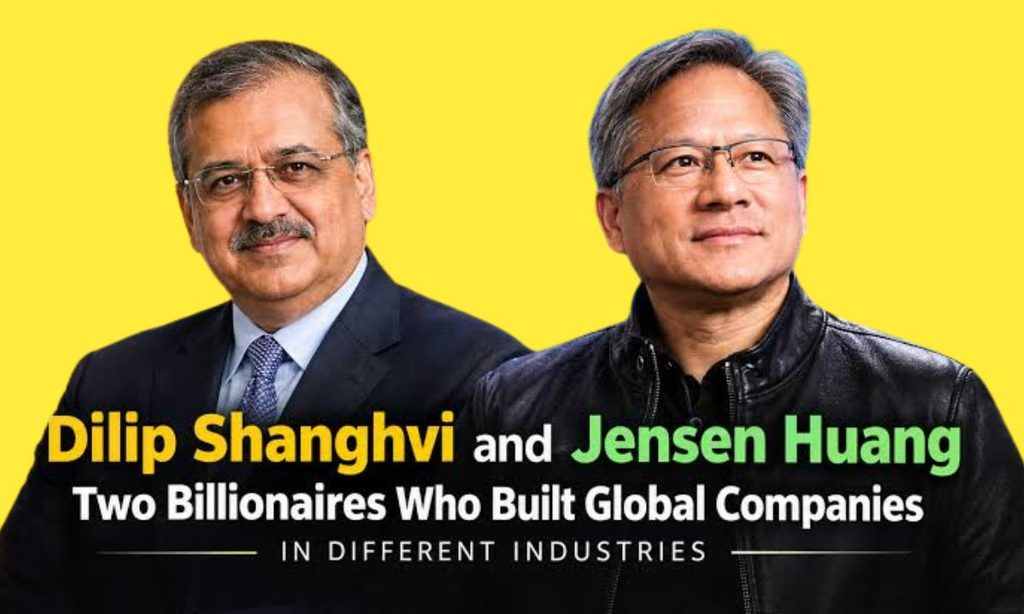
Dilip Shanghvi and Jensen Huang run two very different companies. Shanghvi built Sun Pharma into India’s largest drugmaker. Huang built NVIDIA into the company whose chips power much of today’s artificial intelligence.
Their industries look unrelated, but their journeys share a pattern. Both started small. Both bet on a narrow skill early on. Both kept investing when the payoff was years away.
This guide explains who each leader is, how their companies grew, and how their leadership styles compare. It ends with practical lessons for founders and business students. Here is a quick snapshot first.
| Detail | Dilip Shanghvi | Jensen Huang |
|---|---|---|
| Born | 1955, Amreli, Gujarat, India | 1963, Tainan, Taiwan |
| Company | Sun Pharmaceutical Industries | NVIDIA |
| Founded | 1983 | 1993 |
| Industry | Pharmaceuticals | Semiconductors and AI computing |
| Education | Commerce degree, Kolkata | Electrical engineering, Oregon State and Stanford |
| Known for | Specialty generics and global acquisitions | GPUs, CUDA and AI infrastructure |
Who Is Dilip Shanghvi?
Dilip Shanghvi is an Indian industrialist and the founder of Sun Pharmaceutical Industries. He is widely seen as one of the most disciplined business leaders in India. He rarely gives interviews, and he lets company results speak for him.
Early Life and Entrepreneurial Beginning
Shanghvi was born in Amreli, Gujarat, into a business family. His father ran a pharmaceutical distribution business in Kolkata, so he grew up around medicines, dealers and margins. He studied commerce and joined the family trade after college.
That daily work showed him a gap. Many doctors wanted reliable, well made medicines for chronic conditions, especially psychiatric illness, and few Indian firms served that need well. In 1983 he started a small manufacturing unit at Vapi in Gujarat. It began with just a handful of products, funded with a small loan from his father.
Building Sun Pharma
Sun Pharma grew by focusing on chronic and specialty therapies. Doctors who prescribe for long term illness tend to stay loyal to brands they trust. That gave the company steady demand and better margins than one time acute care products.
Growth then came through careful acquisitions and global expansion. Some key steps are listed below.
- Public listing in the mid 1990s gave the company capital to expand.
- Early entry into the United States market built experience with strict regulators.
- The Ranbaxy merger, announced in 2014, made Sun the largest pharma company in India.
- The full acquisition of Taro in 2024 strengthened its dermatology and specialty portfolio.
- In-house specialty brands, such as Ilumya for psoriasis, moved the company beyond plain generics.
Shanghvi is known for buying troubled companies and fixing them patiently. He tends to keep debt manageable and to reinvest in research.\
Also Read This Blog Richard Peery and Akio Toyoda
Who Is Jensen Huang?
Jensen Huang is the co-founder, president and chief executive of NVIDIA. Born in Taiwan, he moved to the United States as a boy and built his career in Silicon Valley. He is easy to spot at events because of his black leather jacket, and he is known for long, energetic keynote talks.
From Engineering to Entrepreneurship
Huang earned an electrical engineering degree at Oregon State University and a master’s degree at Stanford. He then worked at LSI Logic and AMD, where he learned chip design and how the semiconductor business runs.
In 1993, he co-founded NVIDIA with Chris Malachowsky and Curtis Priem. The founders famously talked through their plan at a Denny’s diner. Their first goal was to bring realistic 3D graphics to personal computers, which was a young and crowded market at the time.
NVIDIA and the AI Revolution
NVIDIA released the GeForce 256 in 1999 and promoted it as the first graphics processing unit, or GPU. Gamers loved it, but Huang saw a bigger use. GPUs can run thousands of small calculations at once, which suits scientific computing.
In 2006, NVIDIA launched CUDA, a software platform that let developers program GPUs for general tasks. When researchers began training deep learning models on GPUs in the early 2010s, NVIDIA was ready. Its data center chips became the standard tool for AI, and the company’s market value passed 4 trillion dollars in 2025.
Dilip Shanghvi and Jensen Huang: Different Industries, Similar Vision
At first glance, medicine and microchips have little in common. Look closer and you see two founders who picked hard fields, built deep expertise, and stayed loyal to their core strength.
Healthcare vs. Technology
Each sector rewards different habits. The table below shows how the two businesses compare.
| Factor | Pharmaceuticals (Sun Pharma) | Technology (NVIDIA) |
|---|---|---|
| Product cycle | Long, with years of trials and approvals | Fast, with new chip generations every year or two |
| Regulation | Very strict, led by bodies like the US FDA | Lighter, but shaped by export rules and trade policy |
| Main growth engine | Specialty drugs, acquisitions, new markets | AI demand, software ecosystem, data centers |
| Biggest risk | Regulatory action and pricing pressure | Competition, supply chains and policy changes |
| Customer loyalty | Doctor trust and patient outcomes | Developer habits and software lock in |
Despite these gaps, both companies rely on trust. Doctors must trust a medicine. Developers must trust a platform. Each leader worked hard to earn that trust before chasing scale.
Long-Term Business Thinking
Neither leader ran his company for the next quarter. Both accepted short term pain for long term strength. Their shared habits include the following.
- Investing in research and development even when profits were thin.
- Building skills in one area before entering a new one.
- Treating setbacks as lessons rather than reasons to quit.
- Keeping the same core team and culture for many years.
Leadership Styles of Dilip Shanghvi and Jensen Huang
Both men lead with conviction, but their public styles could not be more different. One is quiet and private. The other is loud and very visible.
Shanghvi’s Strategic Approach
Shanghvi is a patient dealmaker. He looks for companies with good assets but poor management, buys them at sensible prices, and turns them around. He pays close attention to cost control, compliance and cash flow.
He is also private. He avoids the spotlight and gives his executives room to run day to day work. This calm style helped Sun Pharma stay steady through long regulatory battles and large integrations.
Huang’s Technology-Focused Leadership
Huang leads like an engineer and a teacher. He is deeply involved in product direction and often explains complex ideas in simple terms. He keeps a flat structure and communicates directly with large groups of employees.
He also sets bold, early bets. NVIDIA spent years building CUDA before the market truly needed it. Huang has often said that he wants people to be honest about problems quickly, because fast feedback helps the company adapt.
What Entrepreneurs Can Learn From Their Careers
You do not need a billion dollar company to use their playbook. The ideas below work for small firms, startups and career planning alike.
Focus on the Long Term
Sun Pharma took decades to become a global name. NVIDIA spent more than a decade on CUDA before AI made it essential. Big results often come from steady work that looks unexciting at first.
Ask yourself which investments will matter in five or ten years. Then protect that spending when times get tough.
Adapt to Changing Markets
Sun moved from simple generics to specialty medicines. NVIDIA moved from gaming graphics to AI infrastructure. Neither company stayed still while its market changed.
- Watch how customers use your product in unexpected ways.
- Enter adjacent markets where your skills already give you an edge.
- Be willing to retire products that no longer fit.
Build Strong Capabilities
Real advantage comes from skills that rivals cannot copy quickly. For Sun, that means manufacturing quality, regulatory know how and integration skill. For NVIDIA, it means chip design, software tools and a large developer community.
Build a capability first, and the products will follow.
Also Read This Blog Marillyn Hewson and Igor Olenicoff
Why Dilip Shanghvi and Jensen Huang Remain Important Business Examples
Their stories show that global success is possible from many starting points. Shanghvi grew a company from a small unit in Gujarat into a worldwide pharma group. Huang built a leader in computing from a diner table conversation.
They also show that industry choice matters less than depth. Both picked a field, mastered it and kept improving. That message is useful in any sector.
Finally, they show two valid ways to lead. One works quietly through discipline. The other works loudly through vision. Founders can learn from both and choose what fits their own personality.
Frequently Asked Questions
Who is Dilip Shanghvi?
Dilip Shanghvi is the Indian founder of Sun Pharmaceutical Industries. He built it from a small unit started in 1983 into India’s largest pharma company.
Who is Jensen Huang?
Jensen Huang is the co-founder and CEO of NVIDIA. He has led the company since 1993 and guided its rise from gaming graphics to AI computing.
Are Dilip Shanghvi and Jensen Huang in the same industry?
No. Shanghvi works in pharmaceuticals, while Huang works in semiconductors and AI technology. They are linked by their leadership lessons, not by their sector.
What is the biggest similarity between these two leaders?
Both think long term. Each invested in core strengths for years before seeing large rewards.
Why is Jensen Huang important to artificial intelligence?
NVIDIA’s GPUs and CUDA software became the main tools for training AI models. Huang’s early bet on this market put the company at the center of the AI boom.
What can entrepreneurs learn from their careers?
Focus on the long term, adapt as markets change, and build skills that competitors cannot easily copy.
How did Dilip Shanghvi build Sun Pharma into a global company?
He started with niche products for chronic illness, then expanded through smart acquisitions such as Ranbaxy and Taro. He kept costs and quality under control along the way.
Conclusion
Dilip Shanghvi and Jensen Huang built their empires in separate worlds, yet their paths rhyme. Both began with a narrow focus, kept learning, and stayed patient while others chased quick wins. Shanghvi did it through disciplined acquisitions and steady execution. Huang did it through bold technology bets and constant reinvention.
For entrepreneurs, the message is clear. Pick a field you can master, invest in lasting capabilities, and adjust as the market moves. You may never lead a company as large as Sun Pharma or NVIDIA, but the same habits can help any business grow with confidence.

Shoaib Ahmed is a passionate content writer and language enthusiast who specializes in simplifying complex words, slang, and abbreviations into easy-to-understand meanings. As the creator of MeanFind.com, he is dedicated to helping readers quickly find clear and accurate definitions without confusion.


Pingback: Brian Roberts and Amy Hood: Careers and Leadership