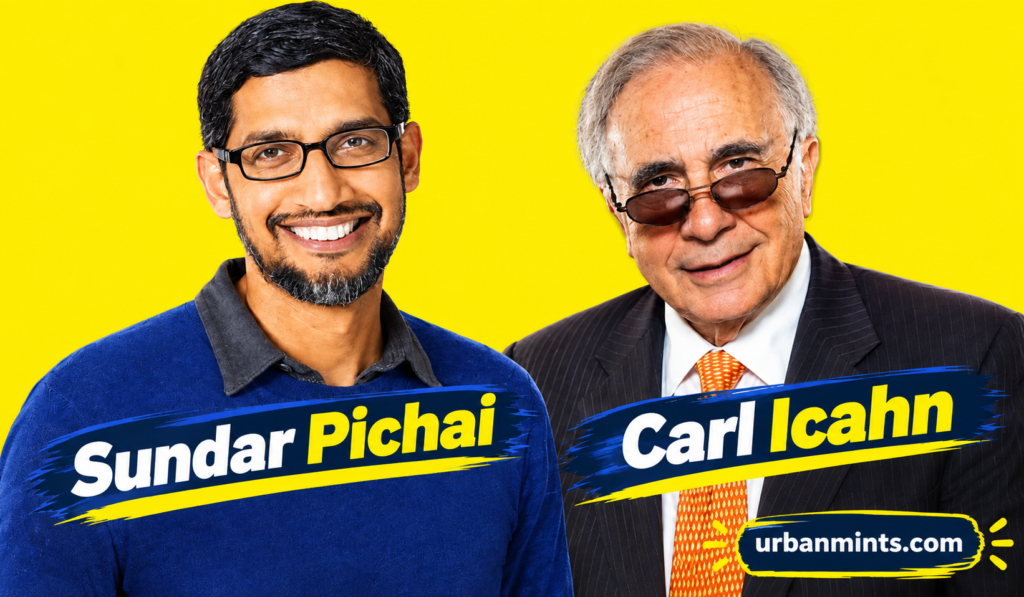
Two powerful names in American business represent very different kinds of influence: one leads a global technology company, while the other built a reputation for challenging corporate management as an activist investor. The story of Sundar Pichai and Carl Icahn becomes particularly interesting when their professional histories intersect with Google’s acquisition of Motorola Mobility in 2011. Although this corporate event connects their worlds, it is important to distinguish a documented business overlap from an alleged personal partnership. Understanding their careers, the Motorola transaction, and each man’s role reveals what their connection actually means.
Who Is Sundar Pichai?
Sundar Pichai is an Indian-born American business executive best known as the chief executive officer of Google and Alphabet, Google’s parent company. He joined Google in 2004 and gradually became one of the company’s most influential leaders through his work on consumer products, software platforms, and product development.
Pichai contributed to the development and growth of Google Chrome, which became one of the world’s most widely used web browsers. His responsibilities later expanded to include major Google products and platforms, such as Android, Search, Maps, Gmail, and Google Play.
He became Google’s CEO in 2015 and took on the additional role of Alphabet CEO in 2019. His leadership has involved overseeing Google’s core advertising business, cloud computing, artificial intelligence, and a broad range of technology products.
Pichai’s professional background is rooted in engineering, product strategy, and corporate management. His role is to guide Google’s long-term direction, manage its operations, and help the company compete in a rapidly changing technology market.
Who Is Carl Icahn?
Carl Icahn is an American investor known for shareholder activism, corporate acquisitions, and efforts to influence how companies operate. Unlike a traditional company executive, he often builds substantial investments in businesses and then pushes management or boards to consider strategic changes.
Icahn began his Wall Street career in the early 1960s and established his investment firm, Icahn & Co., in 1968. Over subsequent decades, he became known for taking significant positions in publicly traded companies and seeking changes that he believes can increase shareholder value.
His investment interests have extended across several industries, including energy, telecommunications, automotive businesses, manufacturing, and real estate. He is also associated with Icahn Enterprises, a diversified holding company.
Icahn’s approach can involve several activities:
- Shareholder activism: Using ownership stakes and shareholder rights to influence corporate decisions.
- Strategic pressure: Encouraging companies to consider asset sales, restructuring, cost reductions, or other operational changes.
- Corporate negotiations: Discussing merger terms, voting arrangements, and other matters that affect shareholder interests.
- Long-term investment decisions: Evaluating whether a company’s strategy and management are creating sufficient value.
These activities help explain why Icahn’s name appears in corporate merger histories, including the Motorola transaction involving Google.
How Sundar Pichai and Carl Icahn Became Connected
The documented connection between Sundar Pichai and Carl Icahn is primarily historical and indirect. It centers on Motorola Mobility, the smartphone manufacturer Google agreed to acquire in 2011.
At that time, Icahn was a significant Motorola Mobility shareholder. Google was interested in acquiring Motorola, partly because of its extensive patent portfolio and its position in the Android smartphone ecosystem.
Pichai was already working at Google during this period, but he was not the company’s CEO. Larry Page held that position, and the public transaction records identify other executives, advisers, and legal representatives involved in negotiating the acquisition.
The merger documents also describe discussions involving Google and Icahn concerning a possible voting agreement. Such an agreement would have addressed how Icahn and his affiliated entities would vote their Motorola shares in connection with the proposed merger.
The important distinction is that Icahn’s documented involvement was connected to his position as a Motorola shareholder, while Pichai was a Google executive building his career in product leadership.
Their names can therefore be connected through the broader corporate history of Google and Motorola, but the available public record does not establish that Pichai personally negotiated with Icahn or that the two men formed a direct business partnership.
You can also read :Peter Buchignani: Career, Football and Family Life
Google’s Acquisition of Motorola Mobility in 2011
The Motorola acquisition provides the clearest explanation for the overlap between their professional histories.
In August 2011, Google announced an agreement to acquire Motorola Mobility for approximately $12.5 billion, equivalent to $40 per share under the announced transaction terms. The deal was completed in 2012 after the required approvals.
Google’s interest in Motorola extended beyond smartphones. Motorola held a large collection of patents relating to mobile communications and other technologies. Those patents were strategically important as competition and legal disputes intensified across the smartphone industry.
The acquisition had several major objectives:
- Strengthening Android: Motorola’s hardware business gave Google a more direct presence in smartphone manufacturing.
- Expanding patent protection: Motorola’s intellectual property could help Google defend Android and its ecosystem in patent disputes.
- Supporting mobile innovation: The transaction offered Google greater control over hardware and software integration.
- Protecting strategic interests: A stronger patent portfolio could improve Google’s position in a competitive technology market.
For Icahn, the transaction was important because he held shares in Motorola Mobility and had an interest in the financial terms and shareholder implications of a potential sale.
For Pichai, the acquisition belonged to the wider Google business environment during his rise through the company’s product organization. However, it would be inaccurate to attribute the deal’s negotiations or final decisions directly to him without supporting evidence.
Sundar Pichai vs. Carl Icahn: Key Differences
| Category | Sundar Pichai | Carl Icahn |
|---|---|---|
| Main profession | Technology executive | Investor and shareholder activist |
| Best known for | Leading Google and Alphabet | Influencing corporate strategy through investments |
| Primary business focus | Technology, software, AI, and digital services | Investments, acquisitions, and corporate restructuring |
| Leadership approach | Managing products, teams, and company strategy | Using ownership stakes to influence company decisions |
| Connection to Motorola | Google executive during the acquisition period | Significant Motorola Mobility shareholder |
| Role in the 2011 transaction | Not identified as a principal deal negotiator in the records reviewed | Involved as a shareholder in discussions concerning the proposed merger |
| Direct business partnership | Not established in the public record | Not established in the public record |
The comparison highlights two different forms of corporate influence. Pichai’s authority comes from executive leadership, while Icahn’s influence has historically come from investment ownership and shareholder activism.
You can also read :Howard Schultz and George Soros: Their Political Connection Explained
Did Sundar Pichai and Carl Icahn Ever Work Together Directly?
There is no clear public evidence establishing a sustained working relationship, personal partnership, or jointly managed business venture between the two men.
Their professional paths overlapped through the Motorola acquisition, but an overlap involving the same company does not necessarily mean two individuals worked together directly.
The publicly documented negotiations surrounding the merger involved Google’s representatives, Motorola Mobility’s management, financial advisers, lawyers, and discussions concerning Icahn’s shareholder position. Pichai is not identified as a principal negotiator in the transaction records reviewed for this article.
This distinction matters because online discussions sometimes turn a corporate connection into a stronger claim than the available evidence supports.
A careful interpretation separates three different possibilities:
- Corporate overlap: Two individuals are associated with the same company or transaction.
- Direct professional contact: Records establish that the individuals communicated or negotiated with one another.
- Business partnership: Evidence shows that the individuals jointly managed, owned, or operated a venture.
The Motorola history supports the first category. It does not, on its own, establish the second or third.
Why Their Business Connection Still Matters
The story illustrates how technology leadership and shareholder activism can intersect during major corporate transactions.
Technology companies often make acquisitions to strengthen their intellectual property, expand their products, or protect their competitive positions. At the same time, large shareholders may evaluate those transactions based on their potential financial returns and the rights attached to their investments.
Pichai’s career demonstrates the influence of executive leadership in shaping a technology company’s products and long-term strategy. Icahn’s career shows how investors can influence corporate decisions without serving as company executives.
Their professional histories also demonstrate why context matters when researching business relationships. A person may be connected to a transaction because they manage the acquiring company, own shares in the target company, advise one of the parties, or negotiate specific terms. These roles are not interchangeable.
For another look at the different ways prominent business figures become connected, read Kobe Bryant and Sam Zell:.
Frequently Asked Questions
Are Sundar Pichai and Carl Icahn business partners?
No documented evidence establishes a direct business partnership between them. Their clearest historical overlap involves Google’s 2011 agreement to acquire Motorola Mobility, in which Icahn was a significant shareholder.
What connects Sundar Pichai and Carl Icahn?
The connection comes from the Motorola Mobility acquisition. Pichai was working at Google, while Icahn held a significant stake in Motorola and was involved in shareholder-related discussions surrounding the proposed merger.
Did Sundar Pichai negotiate Google’s Motorola acquisition?
The transaction records reviewed do not identify Pichai as a principal negotiator. Google’s negotiations involved other executives, advisers, and legal representatives.
Why was Carl Icahn involved in the Motorola deal?
Icahn held a significant Motorola Mobility investment, making the proposed acquisition relevant to his shareholder interests. Discussions included a possible voting agreement related to the merger.
Did Google buy Motorola because of its patents?
Motorola’s extensive patent portfolio was an important strategic consideration, alongside Google’s interest in the mobile-device business and Android ecosystem.
Do Sundar Pichai and Carl Icahn have the same business strategy?
No. Pichai leads a technology company and oversees products, operations, and corporate strategy. Icahn is known for investing in businesses and using shareholder influence to pursue corporate changes.
Conclusion
The real connection between Sundar Pichai and Carl Icahn is best understood through the 2011 Motorola Mobility acquisition. Icahn was a significant Motorola shareholder, while Pichai was a Google executive during the period leading up to the deal. Their professional histories therefore intersect through a major technology transaction, but the available public record does not establish a direct business partnership or show that Pichai personally negotiated the acquisition with Icahn.
Understanding this distinction provides a more accurate view of both men’s careers. One built influence through technology leadership, while the other became known for shareholder activism and investment strategy. Their connection is a useful example of how different roles can intersect within the same corporate event without proving a personal or ongoing business relationship.

Shoaib Ahmed is a passionate content writer and language enthusiast who specializes in simplifying complex words, slang, and abbreviations into easy-to-understand meanings. As the creator of MeanFind.com, he is dedicated to helping readers quickly find clear and accurate definitions without confusion.