
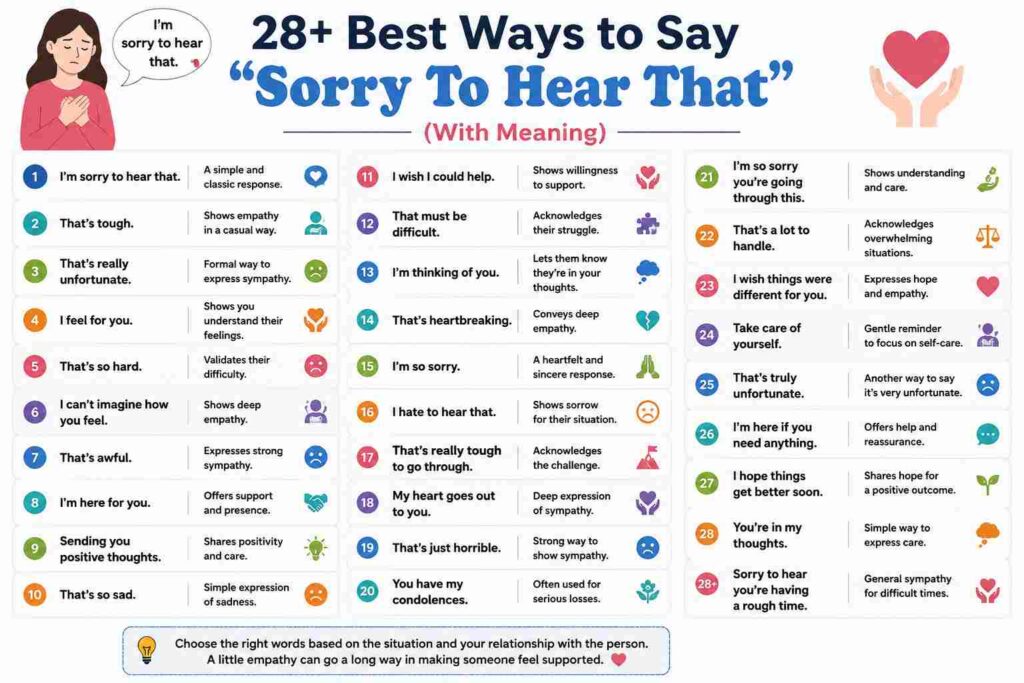
Someone shares bad news, and before you’ve even finished processing it, “sorry to hear that” is already halfway out of your mouth. It’s automatic, it’s polite, and honestly, it can feel a little hollow when repeated too often. If you want your response to actually land to feel like genuine empathy instead of a reflex there are dozens of better ways to say sorry to hear that, each suited to a different relationship and situation. This guide breaks down 28+ alternatives, complete with meanings, examples, and expert insight into how to use them well.
What Does “Sorry To Hear That” Mean?
“Sorry to hear that” is a common expression of sympathy used when someone shares unfortunate or upsetting news. It signals that you’ve registered their situation and feel bad on their behalf, without necessarily taking responsibility for what happened. It’s one of the most widely used empathy phrases in English, appearing in everything from casual conversations to customer service scripts.
When to Use “Sorry To Hear That”
This phrase fits naturally into moments where someone shares:
- A personal setback, illness, or loss.
- Frustrating news, like a cancelled trip or a missed opportunity.
- A difficult situation at work or in their personal life.
- Minor bad luck that still deserves acknowledgment.
It works well as a quick, sincere response, but in more serious or emotional situations, a fuller alternative often shows deeper care.
Is It Professional/Polite to Say “Sorry To Hear That”?
Yes, “sorry to hear that” is generally polite and appropriate in most professional settings, including customer service, workplace conversations, and formal emails. However, in situations involving significant loss or hardship, it can come across as slightly generic if used without any additional warmth or follow-up. Pairing it with a specific offer of support, or choosing a more tailored alternative, often makes the response feel more genuine.
Pros and Cons of Saying “Sorry To Hear That”
| Pros | Cons |
|---|---|
| Universally understood and easy to use | Can feel repetitive or automatic |
| Works in both formal and informal settings | May sound generic for serious situations |
| Quick, low-pressure way to show empathy | Doesn’t always convey deep emotional support |
| Appropriate across most professional contexts | Overuse can reduce its sincerity |
Expert Linguistic Insight for “Sorry To Hear That”
Linguistically, “sorry to hear that” functions as a phatic expression — a phrase used more for social bonding than for conveying detailed information. Communication experts note that phatic empathy phrases are useful for maintaining social connection, but they work best when paired with active listening or a follow-up question. Simply saying the phrase without engaging further can sometimes feel dismissive, even if that’s not the intent.
28+ Alternatives to “Sorry To Hear That”
I’m Truly Sorry to Hear This
Meaning: An intensified version of the original phrase, adding sincerity through the word “truly.”
Example: “I’m truly sorry to hear this — please let me know if there’s anything I can do.”
Best Use: Personal conversations, significant news.
Worst Use: Very brief, casual exchanges.
Tone: Sincere, warm.
My Condolences
Meaning: A formal expression of sympathy, typically reserved for situations involving loss or death.
Example: “My condolences on the passing of your grandfather.”
Best Use: Funerals, formal sympathy messages.
Worst Use: Minor setbacks or everyday bad news.
Tone: Formal, respectful.
I Feel for You
Meaning: Expresses genuine empathy and emotional connection to someone’s difficulty.
Example: “I feel for you — that sounds like an incredibly stressful week.”
Best Use: Close friendships, emotional support.
Worst Use: Formal or professional correspondence.
Tone: Warm, empathetic.
That’s Tough
Meaning: A short, casual acknowledgment that a situation is genuinely difficult.
Example: “That’s tough — I can’t imagine how stressful that must be.”
Best Use: Casual conversations, quick replies.
Worst Use: Formal written communication.
Tone: Casual, sincere.
I’m Sad to Learn This
Meaning: A gentle, reflective way to express sympathy after receiving news.
Example: “I’m sad to learn this — I know how much that project meant to you.”
Best Use: Personal or semi-formal conversations.
Worst Use: Quick, casual texting.
Tone: Reflective, sincere.
Wishing You Strength
Meaning: A supportive phrase offering encouragement during a difficult time.
Example: “Wishing you strength as you navigate this next chapter.”
Best Use: Cards, messages during hardship.
Worst Use: Minor, everyday inconveniences.
Tone: Supportive, encouraging.
I Hope Things Improve
Meaning: An optimistic phrase expressing hope for a better outcome.
Example: “I hope things improve soon — you deserve a break.”
Best Use: Ongoing difficult situations.
Worst Use: Permanent or unchangeable circumstances.
Tone: Hopeful, warm.
I’m Here If You Need Me
Meaning: Offers direct emotional support and availability.
Example: “I’m here if you need me, day or night.”
Best Use: Close relationships, emotional crises.
Worst Use: Formal, distant professional relationships.
Tone: Supportive, personal.
That’s Unfortunate
Meaning: A neutral, slightly formal way to acknowledge bad news.
Example: “That’s unfortunate — I hope the situation resolves quickly.”
Best Use: Professional settings, workplace updates.
Worst Use: Deeply emotional or personal situations.
Tone: Formal, neutral.
I’m Sorry You’re Going Through This
Meaning: Directly acknowledges the person’s ongoing struggle with empathy.
Example: “I’m sorry you’re going through this — it’s completely understandable to feel overwhelmed.”
Best Use: Ongoing hardship, emotional support.
Worst Use: Brief, minor complaints.
Tone: Empathetic, sincere.
That Must Be Hard
Meaning: Validates the difficulty of someone’s situation without minimizing it.
Example: “That must be hard, especially with everything else going on.”
Best Use: Personal conversations, emotional validation.
Worst Use: Formal business communication.
Tone: Validating, warm.
I Understand How You Feel
Meaning: Expresses empathy by acknowledging the emotional weight of the situation.
Example: “I understand how you feel — that kind of news is never easy.”
Best Use: Sensitive, emotional conversations.
Worst Use: Situations where you genuinely can’t relate.
Tone: Empathetic, thoughtful.
That Sounds Rough
Meaning: A casual, relatable way to acknowledge a difficult situation.
Example: “That sounds rough — I’m glad you told me.”
Best Use: Informal conversations, texting.
Worst Use: Formal written correspondence.
Tone: Casual, relatable.
I’m Sad to Hear That
Meaning: A close variation of the original phrase with slightly more emotional emphasis.
Example: “I’m sad to hear that — please take care of yourself.”
Best Use: Personal messages, everyday conversations.
Worst Use: Highly formal business writing.
Tone: Sincere, gentle.
I Can Imagine That’s Difficult
Meaning: Shows empathy while acknowledging you haven’t experienced the exact situation yourself.
Example: “I can imagine that’s difficult, especially given the timing.”
Best Use: Situations outside your personal experience.
Worst Use: When you have directly experienced the same thing.
Tone: Thoughtful, considerate.
That Must Be Frustrating
Meaning: Acknowledges the emotional frustration behind a difficult situation.
Example: “That must be frustrating after putting in so much effort.”
Best Use: Work-related setbacks, minor frustrations.
Worst Use: Deeply emotional or grief-related news.
Tone: Understanding, warm.
I’m Sorry You Experienced That
Meaning: Directly acknowledges a specific negative experience someone went through.
Example: “I’m sorry you experienced that — it wasn’t fair to you at all.”
Best Use: Personal stories, past experiences.
Worst Use: Ongoing, unresolved situations.
Tone: Sincere, validating.
That’s Unlucky
Meaning: A light, casual way to acknowledge minor bad luck.
Example: “That’s unlucky — hopefully next time goes smoother.”
Best Use: Minor setbacks, casual conversations.
Worst Use: Serious or emotionally heavy situations.
Tone: Casual, light.
I Wish Things Were Different
Meaning: Expresses genuine regret about someone’s circumstances.
Example: “I wish things were different for you right now.”
Best Use: Emotional, heartfelt conversations.
Worst Use: Minor, low-stakes situations.
Tone: Heartfelt, sincere.
I’m Here to Support You
Meaning: A direct offer of ongoing help and emotional presence.
Example: “I’m here to support you in whatever way you need.”
Best Use: Close relationships, extended hardship.
Worst Use: Formal or distant professional settings.
Tone: Supportive, warm.
My Heart Goes Out to You
Meaning: A deeply emotional phrase expressing heartfelt sympathy.
Example: “My heart goes out to you and your family during this time.”
Best Use: Loss, grief, significant hardship.
Worst Use: Minor inconveniences or casual bad news.
Tone: Emotional, heartfelt.
That’s Really Hard to Hear
Meaning: Acknowledges that the news itself was difficult to receive, centering shared emotional impact.
Example: “That’s really hard to hear — I’m so sorry.”
Best Use: Unexpected, significant news.
Worst Use: Minor, everyday complaints.
Tone: Sincere, emotional.
I’m So Sorry for Your Loss
Meaning: A specific, formal phrase reserved for situations involving death or significant loss.
Example: “I’m so sorry for your loss — he will be deeply missed.”
Best Use: Funerals, condolence messages.
Worst Use: Non-loss-related situations.
Tone: Formal, respectful.
Please Know I’m Thinking of You
Meaning: A gentle, ongoing expression of care and emotional presence.
Example: “Please know I’m thinking of you during this difficult time.”
Best Use: Cards, messages during hardship.
Worst Use: Quick, casual exchanges.
Tone: Gentle, caring.
That’s a Lot to Deal With
Meaning: Acknowledges the cumulative weight of multiple difficulties at once.
Example: “That’s a lot to deal with all at the same time.”
Best Use: Situations involving multiple stressors.
Worst Use: Single, isolated minor issues.
Tone: Understanding, empathetic.
I Can Only Imagine How You Feel
Meaning: Expresses deep empathy while acknowledging limits of personal understanding.
Example: “I can only imagine how you feel right now.”
Best Use: Situations outside your own experience.
Worst Use: When you’ve directly experienced the same thing.
Tone: Empathetic, humble.
Sending You Strength and Comfort
Meaning: A warm, supportive phrase often used in written messages or cards.
Example: “Sending you strength and comfort during this hard time.”
Best Use: Written notes, cards, messages during hardship.
Worst Use: Spoken, casual conversations.
Tone: Warm, supportive.
That’s Really Unfair
Meaning: Validates the injustice of a situation rather than just its difficulty.
Example: “That’s really unfair — you didn’t deserve that at all.”
Best Use: Situations involving unfair treatment.
Worst Use: Situations caused by circumstance rather than unfairness.
Tone: Validating, sincere.
Which Alternative Should You Use?
Choosing the right alternative depends on three things: your relationship with the person, the severity of the situation, and the setting — spoken, written, formal, or casual. For minor setbacks, lighter phrases like “that’s unlucky” work well. For grief or significant loss, formal options like “my condolences” or “I’m so sorry for your loss” are more appropriate. For ongoing emotional support, phrases like “I’m here to support you” show deeper commitment.
Comparison Table of All Alternatives
| Alternative | Best Use | Tone |
|---|---|---|
| My Condolences | Loss, grief | Formal |
| I Feel for You | Close friendships | Warm |
| That’s Tough | Casual conversations | Casual |
| I’m Sorry You’re Going Through This | Ongoing hardship | Empathetic |
| That’s Unfortunate | Professional settings | Neutral |
| I’m Here to Support You | Extended emotional support | Supportive |
| That’s Really Unfair | Unfair treatment | Validating |
Final Thoughts
“Sorry to hear that” is a reliable, widely understood way to show empathy, but it isn’t the only option and it isn’t always the best fit. Whether you need something more formal like “my condolences,” more casual like “that’s rough,” or more supportive like “I’m here for you,” these 28+ alternatives give you the flexibility to respond with genuine care every time. Just as choosing the right words for a difficult moment matters, so does describing time accurately in everyday writing the same attention to detail behind a phrase like Past Few Days applies here too.
FAQs
What does “Sorry To Hear That” really mean?
It’s an expression of sympathy or empathy, showing that you’ve acknowledged someone’s bad news and feel for their situation.
Is it professional to say “Sorry To Hear That”?
Yes, it’s widely accepted in professional settings, though more specific alternatives can feel more genuine for serious situations.
When should I avoid using “Sorry To Hear That”?
Avoid it for major loss or grief, where more formal phrases like “my condolences” are more appropriate.
What are some professional alternatives?
“That’s unfortunate” and “I understand how you feel” both work well in professional or workplace settings.
Can I use it in informal contexts?
Yes, it works well informally, though casual alternatives like “that’s rough” often feel more natural among friends.
How can I add warmth to the phrase?
Pair it with a specific offer of support, like “let me know if you need anything,” to make it feel more genuine.
Does tone matter?
Yes, matching the tone to the severity of the situation ensures your response feels appropriate rather than dismissive.
Are there cultural differences in usage?
Yes, some cultures favor more formal or reserved expressions of sympathy, while others encourage more open emotional language.
How can I make the phrase feel more genuine?
Follow up with a specific question or offer of help instead of leaving the phrase as a standalone response.
Can it be used in written communication like email?
Yes, it works well in emails, though written messages often benefit from a slightly more detailed or personalized alternative.

Shoaib Ahmed is a passionate content writer and language enthusiast who specializes in simplifying complex words, slang, and abbreviations into easy-to-understand meanings. As the creator of MeanFind.com, he is dedicated to helping readers quickly find clear and accurate definitions without confusion.